
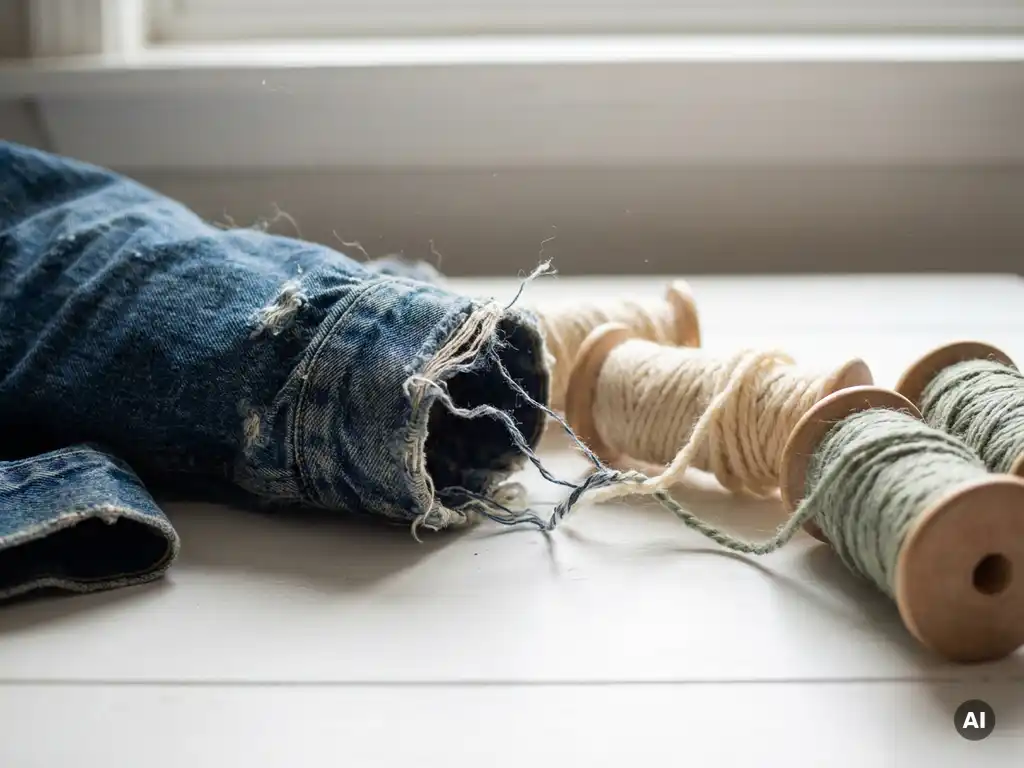
Recycled textiles are produced when old fabrics or fibers are melted down, defibered, or chemically broken down to extract new raw materials. Upcycled textiles, on the other hand, largely retain their original form or structure and are transformed directly—through craftsmanship or creative design—into a new, often higher-quality product. The difference, then, lies in the processing method: recycling breaks down the material, while upcycling elevates it to a new level. The following sections explain what lies behind both processes, which is more sustainable, and how you, as a consumer, can tell the difference.
What happens to a textile during recycling?
In textile recycling, a used garment or piece of fabric is broken down into its basic components to produce new fibers or materials. The end product is generally no longer a recognizable garment, but rather a raw material that is fed back into the production process. This process is a central component of Textile Circular Economy.
There are two basic methods:
- Mechanical Recycling: Textiles are torn apart, shredded, and processed into recycled fibers. This is inexpensive, but the fibers become shorter in the process and lose quality. An old wool sweater, for example, can be turned into insulation or a new, slightly coarser yarn.
- Chemical Recycling: Fibers are broken down at the molecular level and processed into new, high-quality raw materials. This process is technically more complex, but it produces fibers that are virtually as good as new and is particularly well-suited for synthetic fibers such as polyester or nylon.
Important to know: Both methods require energy and resources. Recycling is not a zero-sum game, but it conserves raw materials and water significantly compared to producing new products.
What exactly does "upcycling" mean when it comes to textiles?
In the context of textiles, upcycling means that a used garment or scrap of fabric is transformed directly into a new, often more valuable product without undergoing industrial shredding. The material does not go through a process of breaking down; instead, it is enhanced through design, craftsmanship, or tailoring. For example, an old denim shirt is turned into a bag, and curtains from the 1970s are turned into a coat.
Upcycling takes place on a wide variety of levels:
- Handcrafted and unique: Individuals or small studios transform secondhand items into one-of-a-kind pieces.
- Industrial: Some fashion brands systematically use production scraps or excess inventory for new collections.
- Hybrid: A combination of upcycling and light processing, such as when fabrics are re-dyed but not frayed.
The appeal of upcycling lies in the fact that it saves energy and reduces the number of processing steps. The material retains its value instead of first losing it and then having to rebuild it.
Which materials are suitable for which process?
Not every textile is equally suitable for recycling or upcycling. Choosing the right process depends primarily on the material, the condition of the item, and its fiber composition.
For Recycling The following are well suited:
- Single-fiber materials such as 100 % cotton, 100 % polyester, or 100 % wool
- Textiles that are severely damaged or soiled and can no longer be worn
- Production waste and scrap from manufacturing
For Upcycling The following are well suited:
- Durable fabrics with a structure that is still intact, such as denim, canvas, or leather
- Clothing items with interesting details such as embroidery, buttons, or woven patterns
- Scraps of material large enough to be assembled into new products
Blended fabrics—that is, fabrics made from multiple types of fibers—pose challenges for both processes. They cannot be cleanly separated into individual fibers, nor can they be easily processed further, because the different materials react differently to cutting, heat, or dyeing. This is one of the reasons why sustainable textile production is increasingly relying on single-fiber materials.
Which is more sustainable: recycling or upcycling?
In most cases, upcycling is more energy-efficient than recycling because it requires fewer processing steps. Recycling, on the other hand, can handle larger volumes on a large scale and incorporates materials into the cycle that are no longer suitable for upcycling. Which process is more sustainable depends on the specific application.
A few guidelines can help:
- Upcycling eliminates the energy required for defibration and new production, but it often relies on manual labor and is therefore difficult to scale.
- Chemical recycling consumes energy and chemicals, but in return produces high-quality fibers from material that would otherwise end up in a landfill.
- Mechanical recycling is less expensive, but it results in a loss of quality and is therefore more a form of downcycling than a true closed-loop system.
In a completely imagined Textile Circular Economy The two processes complement each other: Upcycling extends the life cycle of products, while recycling closes the loop at the end. Sustainable textile production requires both.
As a buyer, how can you tell if textiles are recycled or upcycled?
As a shopper, you can identify recycled and upcycled textiles by certain labels, but it requires some attention because these terms aren't uniformly regulated in the retail industry. Here are a few tips to help you make informed purchasing decisions.
At recycled textiles Please note:
- Certifications such as GRS (Global Recycled Standard) or RCS (Recycled Claim Standard), which make the recycling rate verifiable
- Information on the label, such as „made from recycled polyester“ or „contains x % recycled fibers“
- Transparent brands that disclose their supply chains and production locations
At upcycled textiles Please note:
- Information about the origin of the material, such as „from production scraps“ or „from secondhand fabrics“
- One-of-a-kind pieces or limited editions that are a testament to genuine craftsmanship
- Small studios or brands with a traceable history behind every piece
Be cautious of terms like „sustainable“ or „eco“ when they are used without further evidence. These terms are not protected and are sometimes used purely for marketing purposes.
What role does digitalization play in textile recycling?
Digitalization makes textile recycling more efficient, transparent, and scalable. Without digital systems, it is nearly impossible to track which materials are generated where, what they are made of, and where they end up. Yet this is precisely what is needed for a functioning Circular Economy.
Specifically, digitalization helps in several ways:
- Material Tracking: Digital product passports or QR codes on clothing store information about fiber composition, manufacturing steps, and origin. This allows a recycling company to know immediately what it is dealing with.
- Production Planning: Software systems help systematically track material scraps and offcuts from production and make them available for upcycling or recycling instead of disposing of them.
- Operational Data Collection: Sensors and connected machines provide real-time data on how much scrap is generated and where resources are being wasted in the production process.
- Supply Chain Transparency: Digital platforms connect manufacturers, retailers, and recycling companies, making material flows traceable.
The EU Textile Strategy and upcoming regulations, such as the digital product passport, will make this transparency mandatory in the coming years. Companies that invest in digital infrastructure now will be better prepared to meet these requirements.
How update texware Supports Sustainable Textile Management
Here at update texware, we have been developing software for more than 40 years ERP Software for the Textile Industry and actively support textile companies on their path toward greater sustainability and a circular economy. Since 2026, we have been focusing our efforts on projects in the areas of textile recycling and the digitization of circular processes.
Our solutions specifically help you:
- texware/ERP It tracks material flows throughout the entire value chain and identifies where offcuts, scrap, or leftover materials are generated that can be used for recycling or upcycling.
- texware/MES manages production processes in a way that minimizes material waste and uses resources more efficiently.
- texware/Monitoring, provides real-time operational data and lays the digital foundation for transparency in the supply chain.
- Our solutions help you meet the requirements for digital product passports and supply chain transparency before they become legally mandatory.
If you'd like to learn more about how we can help your company digitize circular processes, Please feel free to contact us. We'll show you what's possible with your data and processes.
Related Articles
- Should fashion brands make a complete transition to a circular economy?
- What are the benefits of AI in manufacturing?
- When Is Energy Management Worth It for Textile Manufacturing Facilities?
- How can AI-powered manufacturing be integrated into existing ERP systems?
- What data is needed for predictive maintenance on textile machines?