
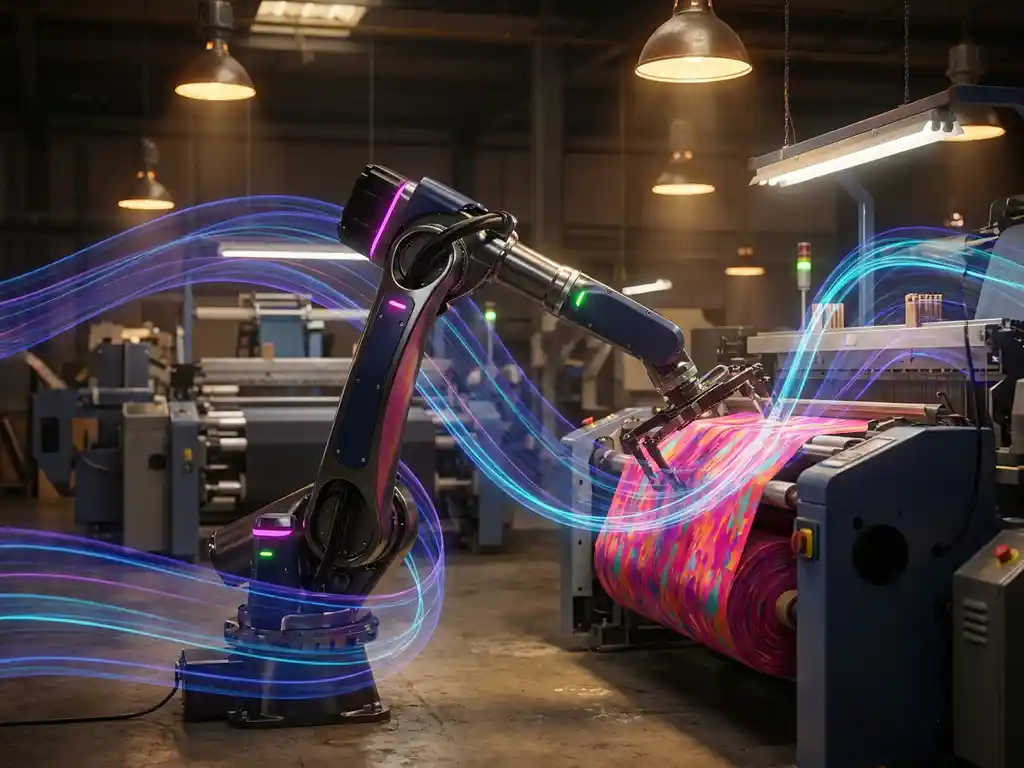
AI in manufacturing helps companies make production processes faster, more accurate, and more cost-effective. It analyzes data in real time, identifies patterns that humans overlook, and supports better decision-making in planning, quality control, and maintenance. This article answers the most important questions about the practical application of AI in manufacturing.
Which specific manufacturing processes does AI improve?
AI improves three key areas in manufacturing: quality control, production planning, and predictive maintenance. In quality control, AI detects defects in real time, often faster and more reliably than manual inspections. In planning, it optimizes machine utilization and delivery times based on current order data. In maintenance, it issues an alert before a machine fails.
This is particularly relevant in the textile industry: weaving defects, color variations, or broken yarns can be detected early on using AI-powered image processing, even before an entire bale of fabric is affected. This saves material and time. At the same time, AI can help to, textile manufacturing processes to coordinate more effectively when multiple machines or departments need to work together.
Other processes that AI specifically improves in manufacturing:
- Automatic Collection and Analysis of Operational Data
- Optimization of Setup Times and Machine Uptime
- Demand-Based Material Planning Based on Order Forecasts
- Identifying Bottlenecks in the Production Flow
- Automated Documentation for Quality Assurance
How does AI reduce production costs and scrap?
AI reduces production costs by identifying waste and continuously optimizing processes. Scrap is often caused by errors that are detected too late. AI analyzes production data in real time and intervenes earlier than a manual inspection process would allow. The result: less material loss, less rework, and lower unit costs.
A typical example: In garment manufacturing, AI can calculate the optimal cut based on pattern data and material parameters, thereby reducing fabric consumption per garment. In yarn production, it can automatically adjust machine parameters when quality sensors detect a deviation. These small adjustments add up over shifts and weeks to yield significant savings.
It’s important to understand that AI doesn’t replace good process planning—it improves it. Those who already have structured processes stand to benefit the most, because AI builds on existing data and analyzes it in a targeted manner.
What is the difference between AI and traditional automation in manufacturing?
Traditional automation performs fixed, preprogrammed steps. AI, on the other hand, learns from data and adapts its behavior to new situations. A robot that repeatedly performs the same action is an example of traditional automation. A system that recognizes that a yarn is behaving differently today than it did yesterday and corrects the machine settings on its own is AI.
So the difference lies not in speed, but in adaptability. Traditional automation excels when processes are stable and predictable. AI is useful when variability comes into play: different material batches, fluctuating demand, or complex interdependencies between machines.
For textile companies, this means that both approaches have their place. Many companies are already relying on traditional automation and are gradually supplementing it with AI capabilities, for example, for quality control or production planning.
When Is AI Worth It for Small and Medium-Sized Enterprises in Manufacturing?
AI is worthwhile for SMEs in the manufacturing sector if sufficient production data is available, recurring problems arise, and manual processes become too slow or prone to errors. You don’t have to start big: Even an AI-powered quality inspection or smart production planning can yield noticeable improvements.
Many small and medium-sized textile companies believe that AI is only for large corporations. That is no longer true. The technology has become more accessible, and many software solutions integrate AI features directly into existing systems. What matters isn’t the size of the company, but rather the question: Is there a specific process that regularly causes problems?
Typical entry points for SMEs:
- Automated Defect Detection in Product Inspection
- AI-Powered Sequencing Planning for Orders
- Forecast-Based Material Planning
- Anomaly Detection in Machine Data
Those who start with one of these areas and gain experience can gradually expand their use of AI without having to transform the entire company all at once.
What data does AI need to function in manufacturing?
AI in manufacturing requires structured, consistent, and sufficiently extensive data. This can include machine data, order data, quality metrics, or material information. The more relevant data points are available and the longer they are collected, the better an AI system can learn from them.
In practice, this means that companies that already collect their production data digitally have a clear advantage. Those who still rely on paper or spreadsheets must first establish a digital foundation. This is not a disadvantage, but rather a necessary step that is well worth the effort.
Relevant data sources in textile manufacturing include, for example:
- Machine Sensors and Production Data Collection
- Order data from the ERP system
- Quality inspection reports and scrap statistics
- Vendor and Material Master Data
- Shift and Production Logs
Good data quality is more important than large amounts of data. An AI system that works with clean, complete data delivers more reliable results than one based on incomplete or inconsistent sources.
How is AI changing the role of employees in textile production?
AI is changing the role of employees in textile production not by replacing them, but by reducing their workload. Routine tasks such as manual data entry, visual error detection, and the preparation of shift reports are increasingly being handled by software. Employees are able to focus more on tasks that require experience, judgment, and direct customer contact.
This is a shift, not a threat. In practice, well-implemented AI systems have been shown to increase acceptance within the team when employees recognize that the technology takes work off their hands rather than calling their competence into question. Key to this are a transparent rollout and clear communication about what the system can and cannot do.
New skills are becoming increasingly important: interpreting data analyses, adjusting AI parameters, and critically evaluating system recommendations. These are skills that employees can develop with the right training and that will increase their value to the company in the long term.
How update texware Helps with AI in Manufacturing
Here at update texware, we know that for many textile companies, getting started with AI raises a number of questions: What data do you need? Which processes will benefit the most? And how does this fit in with your existing software?
This is exactly where our solutions come in. With texware/ERP as your digital foundation, you can capture and organize all relevant production data required by AI functions. Complementary modules build on this foundation in a targeted manner:
- texware/MES manages and documents your production processes in real time and provides the data foundation for AI-driven analyses.
- texware/Monitoring, It collects operational data directly from machines and makes it available for analysis.
- texware/DeepSee analyzes production and order data using business intelligence functions and supports data-driven decision-making.
- texware/Inspection It digitizes the product inspection and creates a structured foundation for automated quality assessments.
We’ll guide you from the very first step through to day-to-day operations, with consultants who come from the textile industry and understand your processes. Take a look at our Software Products at a Glance or Please contact us directly, to find out which solution is right for your business.
Related Articles
- What are the most common causes of high energy consumption in textile factories?
- Which machines consume the most electricity in textile production?
- When Is Energy Management Worth It for Textile Manufacturing Facilities?
- How do you implement energy management in the textile industry?
- When Is AI-Based Production Control Worth It in a Textile Manufacturing Facility?