
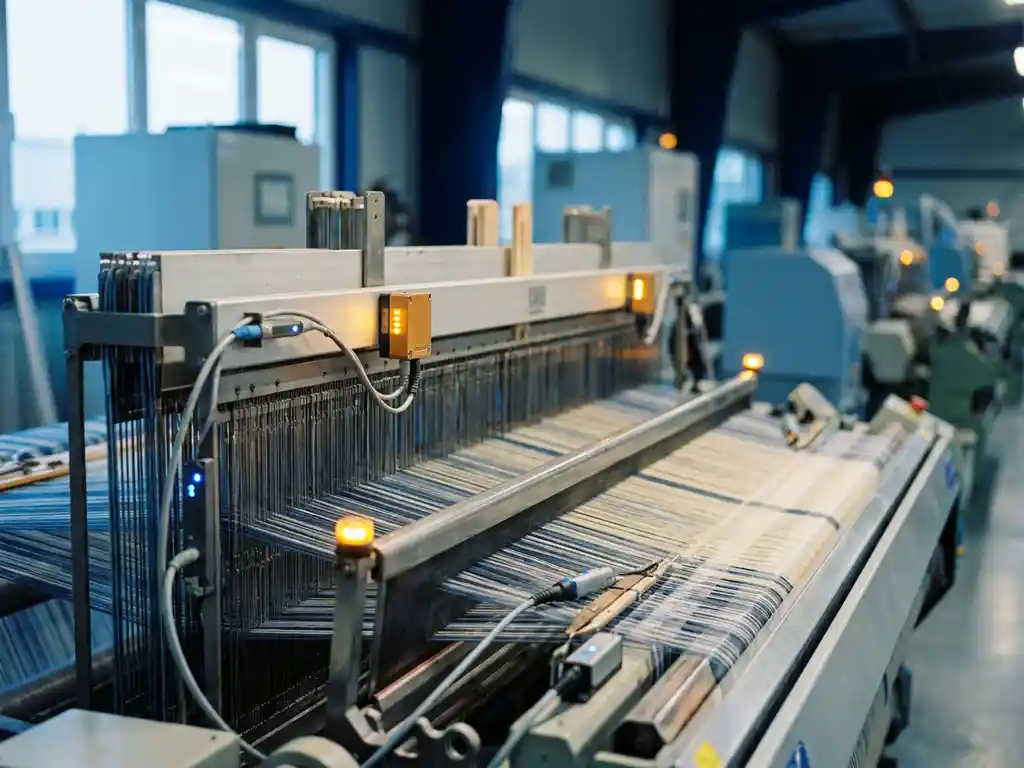
Predictive maintenance for textile machinery primarily requires real-time operational data from running machines: temperature, vibration, power consumption, and operating times are at the core. Historical maintenance data and production logs are also needed so that a predictive model can identify patterns and flag impending failures early on. In this article, we answer the most important questions regarding data collection, system integration, and getting started for smaller textile companies.
Which machine parameters provide the most valuable warning signals?
The most valuable warning signs come from four parameter areas: vibration behavior, temperatures at bearings and drives, electrical current consumption, and operating times and cycle data. These values change measurably before a component actually fails, giving you a concrete head start in taking action.
In weaving machines and circular knitting machines, it is often the bearings on the main drive shafts that are the first to show signs of wear. A slightly elevated vibration level that gradually increases over several shifts is a classic early warning sign. The same applies to needle bars in knitting machines: If the drive’s current consumption increases while production speed remains constant, this indicates mechanical resistance, often caused by fiber buildup or wear on guide elements.
At the Energy Monitoring in the Textile Industry Power consumption plays a special dual role: It indicates both energy usage and the machine’s condition. A machine that suddenly draws more energy for the same product is operating inefficiently or is struggling against mechanical resistance. This is a warning sign that many companies have simply failed to evaluate so far because the data is not systematically collected.
- Vibration: Bearings, Shafts, Belt Drives
- Temperature: Motor windings, transmission oil, bearing housings
- Current consumption: Drive motors, heating units
- Duration and Cycles: Shot count, revolutions, hour meter
- Pressure readings: Hydraulic and Pneumatic Circuits in Finishing Plants
How is operational data from textile machines collected and transmitted?
Operational data from textile machines is collected via sensors, machine-integrated controllers (PLCs), or external data acquisition units and then transmitted to higher-level systems via a network, the OPC UA protocol, or proprietary interfaces. Modern machines already provide many data points digitally, while older systems can often be retrofitted with sensor solutions.
In practice, it works like this: On a loom with a Siemens control system, an OPC UA client directly reads the weft count, rotational speed, and error codes. On an older ring spinning machine without a digital interface, a vibration sensor is mounted on the bearing housing and a current sensor on the main drive; these sensors send their measured values to a gateway via the MQTT protocol.
The gateway aggregates all signals and forwards them either to a cloud platform, a local data center, or directly to a MES System for Textile Companies. The sampling rate is crucial for data quality: Vibration measurements require significantly higher frequencies than temperature data, which changes more slowly.
How much historical data does a forecasting model need?
A predictive maintenance model for textile machinery typically requires at least six to twelve months of historical operating data to identify seasonal fluctuations and typical failure patterns. The more failures and maintenance events are documented in the data, the more accurate the predictions become.
That sounds like a lot, but many companies already have data without even realizing it. Machine failure logs, handwritten maintenance logs, and shift reports are historical data that can be digitized and used as a basis for training. If you start systematically collecting data today, you’ll have a solid database in twelve months.
Data quality is key here: A model trained on incomplete or incorrectly labeled data will produce unreliable predictions. It’s better to have a few well-documented data points than a large amount of poorly structured raw data. Therefore, start with two or three machines that you monitor thoroughly and consistently before expanding the rollout to the entire production line.
What is the difference between condition-based maintenance and predictive maintenance?
Condition-based maintenance responds to current measurement values: If a threshold value is exceeded, this triggers a maintenance action. Predictive maintenance goes one step further: It analyzes data patterns over time and predicts when a component is likely to fail, even before a threshold value is reached.
Condition-Based Maintenance: Respond When a Value Changes
In condition-based maintenance, fixed thresholds are set—for example, a maximum bearing temperature of 85 degrees. As soon as the sensor reports this value, maintenance is performed or the part is replaced. This is already significantly better than purely time-based maintenance according to a calendar schedule, because action is taken only when it is actually necessary.
Predictive Maintenance: Identifying Patterns Before Value Dips
Predictive maintenance for textile machines uses algorithms that monitor the trend of a parameter. If the bearing temperature rises by 0.3 degrees daily over a three-week period, the model detects this trend and reports that the threshold will be reached in about two weeks. You can then schedule maintenance during a planned production shutdown instead of experiencing an unplanned stoppage.
How is maintenance data integrated into an ERP system for textile companies?
Maintenance data is fed into operational planning via interfaces between the machine data collection system and the ERP system. The ERP system receives maintenance orders, plans resources and spare parts, and links downtime directly to production and cost analyses.
In practice, this means: If the monitoring system reports an elevated vibration level on weaving machine 7, it automatically generates a maintenance order in the ERP system. The system checks whether the required replacement part is in stock, reserves it from the inventory, and schedules the repair for the next maintenance-free shift. The production planner immediately sees the interruption in their capacity plan.
This integration is what truly adds value. Without a connection to the ERP system, predictive maintenance remains an isolated tool. With this connection, it becomes part of the overall operational workflow, from the Textile Company and Its Production all the way through to financial accounting, because maintenance costs are allocated directly to the correct cost centers.
When is predictive maintenance worthwhile for small textile companies?
Predictive maintenance is worthwhile for small textile companies as soon as unplanned machine breakdowns regularly jeopardize delivery deadlines or repair costs account for a significant portion of operating income. This isn’t just an issue for large factories: a breakdown hits small businesses with limited machine redundancy particularly hard.
A sensible first step is not to implement a complete monitoring system for all machines at once. Start with your two or three most critical pieces of equipment—that is, those where a failure would immediately halt production or where repairs are particularly expensive. Equip them with simple sensor solutions and integrate the data into your maintenance planning.
The cost of basic sensor gateways and basic data analysis has dropped significantly today. Many solutions can be implemented without a major IT effort and then scale along with your business. If you Energy Monitoring in the Textile Industry By using this as a starting point, you’ll also gain insight into your energy consumption, which pays for itself in many businesses in just a short time through cost savings.
How update texware supports you with predictive maintenance and energy monitoring
Here at update texware, we’ve been developing software exclusively for the textile industry for more than 40 years. That means you don’t have to explain to us how a ring spinning machine works or why unplanned downtime in garment manufacturing is particularly critical. We understand your processes.
For predictive maintenance and operational data collection, we offer specific solutions that are tailored to your textile production:
- texware/Monitoring, collects machine data in real time and provides it as a digital platform for energy monitoring and condition monitoring
- texware/MES links machine data with production control so that maintenance events are directly incorporated into capacity planning
- texware/ERP integrates maintenance orders, spare parts inventory, and maintenance costs into your company's overall business management
- Modular design: You start with what you need now and expand step by step
- Cloud, data center, or on-premises operation—whichever best suits your IT infrastructure
If you'd like to know which solution is right for your business and what a realistic first step would look like, Please feel free to contact us. Together, we'll take a look at where you stand today and what data you already have.
Related Articles
- How do you get started with sustainable textile production in your business?
- How does AI improve production planning in textile companies?
- How does predictive maintenance work for textile machines?
- How does energy monitoring reduce production costs in textile companies?
- How can AI-powered manufacturing be integrated into existing ERP systems?