
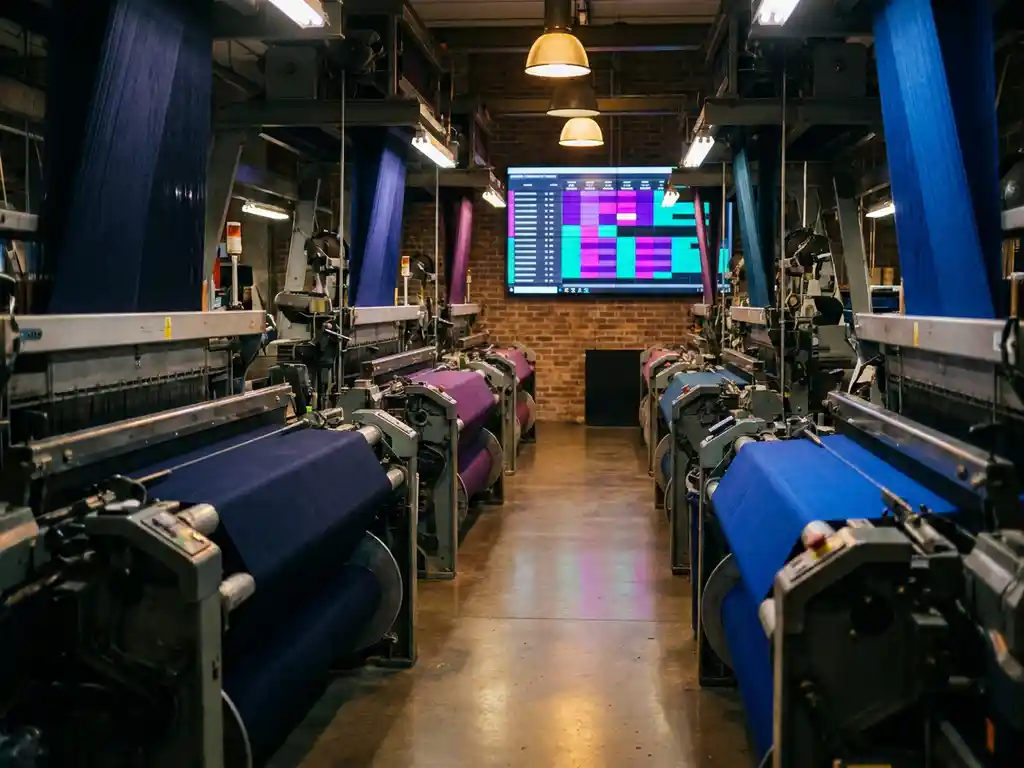
AI improves production planning in textile companies by automatically coordinating orders, machine capacity, and material availability, responding significantly faster and more accurately than manual planning. This is especially true when many variables must be taken into account simultaneously, such as yarn colors, weaving widths, delivery dates, and setup times. The following questions illustrate how this works in practice and when it’s worth getting started.
What specific tasks does AI handle in textile production planning?
In textile production planning, AI handles tasks such as automatically optimizing the sequence of production orders, predicting bottlenecks, and dynamically adjusting schedules in the event of disruptions. It analyzes patterns in historical production data and suggests specific actions before problems arise.
In practice, this means, for example, that an AI system recognizes that a particular machine will be overloaded on a Thursday and automatically redistributes orders. Or it determines that a certain type of yarn is running low and reprioritizes the orders accordingly. An overview of typical tasks:
- Capacity planning across multiple machines and shifts
- Prioritizing Orders Based on Delivery Dates and Setup Times
- Early Detection of Material Shortages
- Automatic rescheduling in the event of machine downtime or order changes
- Predictive Maintenance Recommendations Based on Operational Data
The difference from traditional planning is not that AI makes all the decisions on its own, but rather that it supports the planner with specific suggestions and scenarios that the planner would otherwise have to calculate manually for hours.
How does an AI system learn the specifics of the textile industry?
An AI system learns the specifics of the textile industry by being trained on industry-specific production data, such as setup times for color changes, scrap rates by material type, or seasonal order patterns. The more relevant data the system receives, the better its recommendations align with the reality of the operation.
Textile processes have unique characteristics that a general AI model does not automatically recognize. A weaving company uses different planning logic than a garment manufacturer or a yarn dyeing facility. That is why it is important that the system not only uses general optimization algorithms but is also trained with data from the company’s own operations and from comparable textile processes.
In practice, the learning process occurs in two steps: First, the system comes equipped with basic knowledge of typical textile processes, for example through preconfigured models. Then, through ongoing operation, it adapts to the specific conditions of the company. This is also known as continuous learning or machine feedback. So, those who start data collection early will have a clear advantage later on.
What is the difference between AI-powered and traditional production planning?
The most important difference lies in the speed of response and the number of variables that can be taken into account simultaneously. Traditional production planning is based on manual decisions and fixed rules. AI-powered planning continuously analyzes real-time data and dynamically adjusts plans without requiring a planner to initiate each step individually.
Traditional Production Planning: Strengths and Limitations
Traditional planning works well when processes are stable and manageable. An experienced planner knows their machines and understands what is realistic. Problems arise when many orders are running simultaneously, delivery dates change on short notice, or materials are missing. In such cases, manual coordination quickly becomes confusing and error-prone.
AI-Powered Planning: What Makes It Different in Practice
AI-powered systems process significantly more information simultaneously and can calculate alternative scenarios within seconds. They learn from past decisions and improve their recommendations over time. It’s important to understand that AI does not replace the planner; rather, it provides the planner with better tools. The final decision is still made by a human.
What data does AI need to improve production plans?
Above all, AI requires structured, up-to-date data from day-to-day operations: machine utilization, order data, material inventories, setup times, and delivery dates. The more complete and consistent this data is, the more useful the system’s planning recommendations will be.
Specifically, this concerns the following categories of data:
- Order Details: Quantity, Item, Delivery Date, Priority
- Machine data: Availability, Capacity, Current Occupancy, Maintenance Status
- Material Data: Inventory, Open Orders, Delivery Times
- Process data: Setup times, scrap rates, lead times by item
- Historical data: Past Orders, Variances from Plan, Seasonal Patterns
Many textile companies already have this data, but it is often scattered across different systems or spreadsheets. A integrated ERP system This is therefore a prerequisite for the effective use of AI. Without a clean database, even the best AI model cannot produce reliable results.
At what point does AI become worthwhile for small textile companies in production planning?
AI in production planning is worthwhile for small textile companies as soon as manual planning regularly leads to bottlenecks, scheduling problems, or unused machine capacity. There is no set minimum size, but a certain order volume and a digital database are prerequisites.
As a general guideline: If a company coordinates more than ten to twenty concurrent production orders daily and regularly finds itself under time pressure, AI support makes sense. On the other hand, companies that handle only a few similar orders per week will initially benefit more from a robust ERP system with structured planning than from AI algorithms.
For smaller businesses, the best way to get started is often not a full-fledged AI planning system, but rather a first step toward digital textile production: Collect operational data, standardize processes, and implement an ERP system. On this basis, AI can then be expanded step by step.
How can AI be integrated into an existing textile ERP system?
AI can be integrated into an existing textile ERP system by connecting AI modules directly to the existing database—for example, via interfaces or as a native extension of the system. It is crucial that the AI accesses the same production and order data that the ERP system already manages.
In practice, there are two common approaches:
- Integrated AI Modules: Some modern ERP systems offer AI capabilities as an integral part of the software. This is the easiest approach because no additional interface is required and the data remains consistent.
- External AI tools with integration: Specialized planning tools are integrated with the existing ERP system via APIs or interfaces. This offers greater flexibility but requires more effort in terms of implementation and data maintenance.
Important to note when getting started: Not every ERP system is equally well-suited for AI integration. Systems that were developed for the textile industry from the outset often already have the right data structures to make effective use of AI functions. Those who use a general-purpose ERP system often have to invest more effort in data adaptation.
How update texware Helps with AI-Powered Production Planning
Here at update texware, we have been developing software exclusively for the textile industry for more than 40 years. This means that our consultants have hands-on experience with the specifics of textile production processes and don’t need to be told how setup times for color changes or capacity planning in weaving mills work.
With texware/ERP and its complementary modules, we provide a foundation on which AI-powered planning truly works:
- texware/MES Collects operational data in real time directly from the machine and provides the data foundation for intelligent planning algorithms
- texware/Planboard visually displays production schedules and highlights bottlenecks at a glance
- texware/Monitoring, digitizes production processes and creates the transparency that AI systems need
- texware/DeepSee analyzes historical data and supports forward-looking decisions in planning
- Modular design: You start with what you need and expand gradually
- Cloud, data center, or on-premises operation, depending on your IT infrastructure
If you'd like to know which modules are right for your business and what the first steps actually involve, Please contact us directly. We'll take a look at your situation and show you which steps are realistic and practical.
Related Articles
- How can energy consumption in textile production be optimized by 2026?
- How does AI-powered production control work in the textile industry?
- When Is AI-Based Production Control Worth It in a Textile Manufacturing Facility?
- When Is Energy Monitoring Worth It for Small Textile Companies?
- How do you get started with energy monitoring in textile production?