
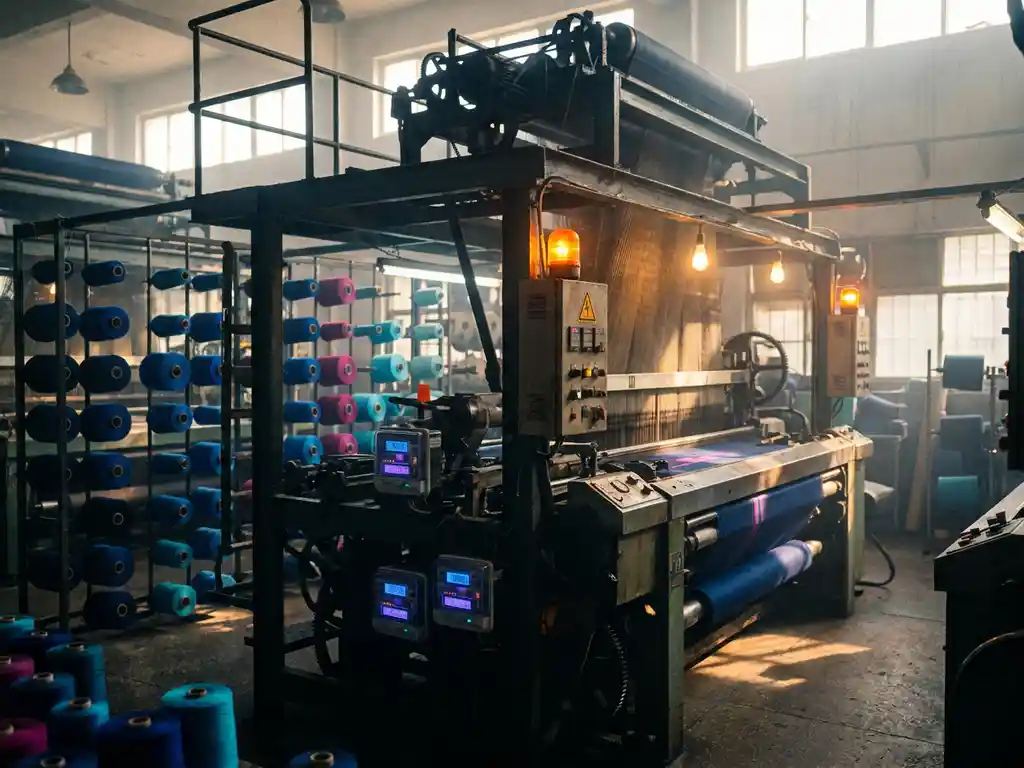
In textile production, dyeing and finishing machines, drying systems, and spinning machines consume the most electricity. Weaving and knitting machines follow, with similarly high energy requirements that vary depending on the technology used. If you want to truly understand electricity consumption in your production process, you need to know which machines are the biggest consumers and why that is the case. The following questions provide concrete answers.
Which production processes drive up electricity consumption the most?
The most energy-intensive processes in textile production are wet finishing, drying, heat setting, and spinning. These processes require not only mechanical energy for drives but, above all, thermal energy, which is often generated using electricity or steam. Together, they account for the majority of total energy consumption in many plants.
Energy consumption is particularly noticeable wherever water must be heated, steam generated, or air brought to high temperatures. This applies to dyeing facilities, finishing departments, and drying lines. Mechanical processes such as weaving or knitting are significantly less energy-intensive by comparison, even though they still consume significant amounts of energy due to long machine operating times.
For a systematic Energy Monitoring in Production It is important to track and evaluate these processes separately, rather than focusing solely on total consumption.
Why do dyeing and finishing machines consume so much energy?
Dyeing and finishing machines consume so much electricity because they must heat large volumes of water to high temperatures while simultaneously performing mechanical movements. Added to this are the subsequent energy-intensive drying and setting processes. The combined demand for thermal and mechanical energy makes these systems the largest consumers of electricity in textile production.
Specifically, the following factors play a role:
- Water temperatures: Many dyeing processes take place at temperatures ranging from 60 to over 130 degrees Celsius, depending on the fiber and dye.
- Long processing times: Dye baths often have to be maintained for hours, which increases energy consumption.
- Drying systems: After the wet process, the fabric must be dried, often in tension frames or drum dryers that require a lot of heat.
- Heat setting: Fusing synthetic fibers requires precise temperatures above 180 degrees, which also consumes a lot of energy.
Those who want to save energy in this area therefore have the greatest potential. Even small improvements in temperature control or bath volume can have a significant impact on energy bills.
How much electricity does a weaving machine use compared to a knitting machine?
Weaving machines generally consume more electricity than knitting machines with comparable production capacity. Depending on their width and type, a modern high-performance weaving machine can consume between 5 and 15 kilowatts per hour. Knitting machines often consume less, although circular knitting machines are more efficient than flat knitting machines with complex pattern requirements.
The difference lies primarily in the mechanical effort involved: weaving machines must open the shed, insert the weft, and perform the pick, often several hundred times per minute. This generates high peak loads. Knitting machines operate with less mechanical resistance, but they also consume significant amounts of energy during long operating periods.
For energy monitoring in textile plants, this means that weaving and knitting operations should be measured separately, because their consumption profiles are very different. This is the only way to specifically identify opportunities for optimization.
What are the biggest energy consumers in a spinning mill?
In the spinning mill, ring spinning machines, rotor spinning machines, and the associated preparatory machines—such as carding machines and draw frames—are the largest consumers of electricity. Ring spinning machines are considered particularly energy-intensive because they require a separate drive for each spindle and operate at very high speeds.
Other relevant consumers in the spinning mill include:
- Air Conditioning and Humidification Systems: Spinning mills require precise humidity and temperature control, which results in high energy consumption by the HVAC system.
- Exhaust Systems: Fibers and dust must be continuously extracted, which requires high-powered fans.
- Rotor spinning machines: Although they are more efficient than ring spinning machines, they are still a significant source of energy consumption when production volumes are high.
Detailed energy monitoring is particularly worthwhile in spinning mills because many machines run around the clock and idle times are often not recorded.
How can textile companies reduce their machines' electricity consumption?
Textile manufacturers can reduce their electricity consumption by first implementing accurate consumption measurements for each machine and process, then specifically reducing idle time, and finally using more energy-efficient drives and control systems. Without measurement, there is no basis for improvement.
Specific measures that are effective in practice:
- Implement machine-specific monitoring: Only those who know which machine consumes how much and when can take targeted action.
- Reduce Idle Time and Standby Time: Machines that aren't producing anything but are still drawing power are an often-underestimated cost factor.
- Using a variable-frequency drive: Many drives operate at full power even though production does not require it. Variable-frequency drives adjust the speed to match actual demand.
- Take Advantage of Heat Recovery: Waste heat can be recovered and used for preheating, particularly in wet finishing processes.
- Optimizing Production Planning: Consolidating machines, minimizing setup times, and avoiding peak loads structurally reduces electricity consumption.
What role does production planning play in energy efficiency?
Production planning has a direct impact on energy consumption because it determines when which machines run, how often changeovers occur, and whether peak loads arise. Well-planned production reduces unnecessary machine runtime and avoids costly peak loads in the power grid, for which many energy providers charge a separate fee.
For example, companies that schedule energy-intensive processes—such as dyeing or heat setting—during periods with lower electricity rates pay less without changing their production. Those who bundle orders so that machines need to be started from a cold state less frequently save on startup energy. And those who minimize setup times reduce the amount of time machines are running but not producing anything.
The connection between Production Planning and Energy Monitoring has not yet been implemented in many companies. Yet this is one of the areas with the greatest potential for structurally reducing electricity consumption in textile production without having to invest in new machinery.
How update texware helps you reduce energy consumption in your textile production
Here at update texware, we know that energy costs are a real competitive factor in the textile industry. That's why we've developed solutions to help you measure consumption, optimize planning, and reduce costs in a targeted manner.
Here's what we specifically offer you:
- texware/Monitoring: Our production data collection system captures machine data in real time, including energy consumption data for each machine and shift. This provides you with the foundation for true energy monitoring in your textile production.
- texware/Planboard: The graphical production control center helps you plan orders in a way that avoids peak workloads and optimizes machine uptime.
- texware/MES: Production control links planning and execution, allowing you to identify and specifically reduce downtime.
- texware/DeepSee: With our business intelligence tool, you can analyze consumption data, identify trends, and visualize potential savings.
All of this comes from a single source—a team that knows the textile industry inside and out. You don’t need to explain to us how your production works. We’re already familiar with the processes.
If you'd like to know how we can specifically support your business, Please contact us now and together we'll identify where your greatest potential lies.
Related Articles
- What is the difference between AI-driven manufacturing and traditional production planning?
- How does energy monitoring reduce production costs in textile companies?
- How does AI help small textile businesses with digital transformation?
- What data is needed for predictive maintenance on textile machines?
- How can electricity consumption be reduced in a textile manufacturing facility?