
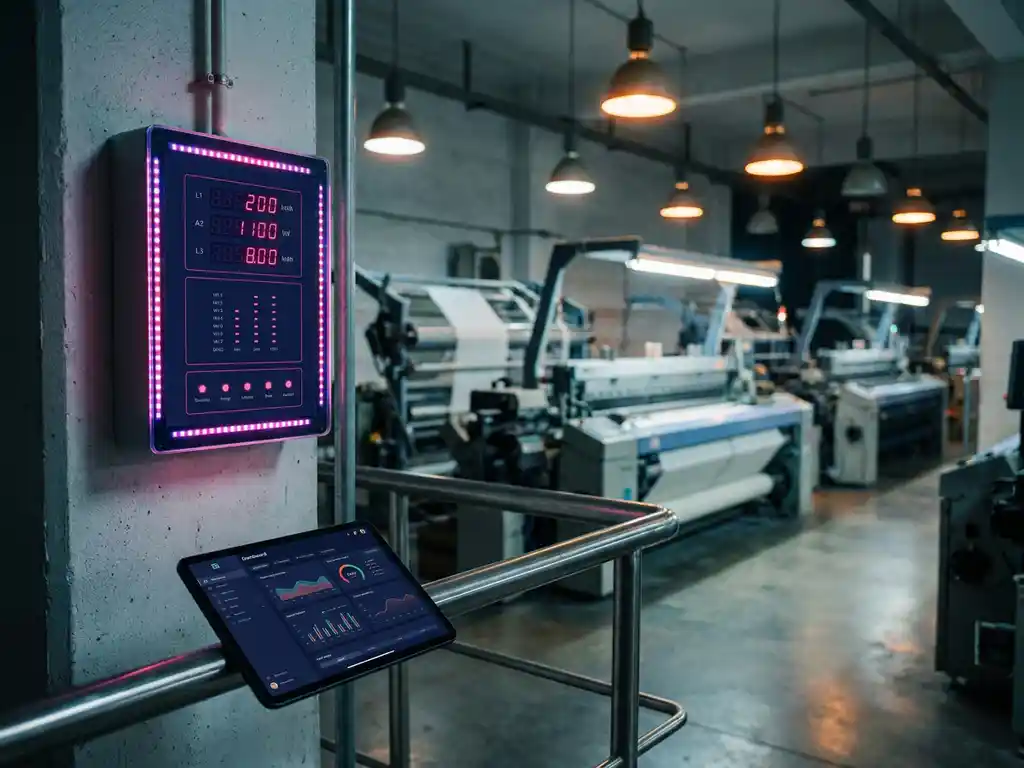
The best way to get started with energy monitoring in textile production is to first identify the largest electricity consumers in your facility and begin there using simple measuring devices or a digital monitoring system. Even with a modest amount of effort, you can uncover potential savings of 10 to 30 percent in energy consumption without needing a large budget right away. The following sections will show you, step by step, what matters most.
Which energy-consuming equipment in textile production is worth monitoring?
In textile production, monitoring is particularly worthwhile for machines with long operating times and high power consumption: weaving machines, knitting machines, dyeing equipment, drying machines, compressors, and air conditioning systems are typically among the biggest energy consumers. Focusing on these areas yields the fastest and most noticeable savings in Electricity Consumption in Textile Production.
Specifically, you should prioritize the following areas:
- Thermal Processes: Dryers, setting machines, and dyeing systems consume a particularly large amount of thermal energy. Fluctuations in energy demand often indicate process problems.
- Compressed Air Systems: Compressors run around the clock in many facilities and are often improperly adjusted. Leaks and idle time cost a lot of money.
- Lighting and Air Conditioning: Often underestimated, but a significant factor in large production facilities, especially when there is no automated control system in place.
- Drives and Motors: Older electric motors without variable-frequency drives often run at full load, even when production doesn't actually require it.
A good place to start is with a simple assessment: Which machines are running, and for how long? Which processes generate the most heat? These questions will help you focus your monitoring efforts where they’ll really make a difference.
How does energy monitoring work technically in a textile factory?
Energy monitoring in a textile plant is carried out using sensors attached to machines, electrical circuits, or power lines that collect consumption data in real time. This data is fed into central software, which analyzes it, visualizes it, and triggers an alarm in the event of deviations. The basic principle is simple; implementation depends on the size of the facility and the existing infrastructure.
Measurement Points and Sensors
Modern systems use so-called clamp-on sensors or smart meters, which can be connected to existing electrical circuits without major modifications. A measurement point is set for each machine or group of machines. The data is transmitted either via cable or wirelessly to a gateway, which forwards it to the software.
Software and Analysis
The monitoring software does the actual work. It shows you which machines are consuming how much electricity and when, identifies patterns, and highlights anomalies. Good systems allow you to break down consumption data by shift, machine type, or job. This is particularly useful when you Energy consumption per production order would like to understand.
How much does it cost for small and medium-sized businesses to get started with energy monitoring?
For small and medium-sized textile companies, the initial cost of implementing energy monitoring ranges from a few hundred to several thousand euros, depending on the scope of the project. Simple solutions using individual smart meters and cloud-based software can be implemented for less than 1,000 euros. Scalable systems for multiple machines and detailed analyses typically cost between 3,000 and 10,000 euros for the initial installation.
Important to know: In many businesses, the initial costs pay for themselves within one to two years because the potential savings identified exceed the investment. Federal and state subsidy programs, such as those offered by the BAFA or KfW, can cover a portion of the costs. It’s worth checking which programs are available in your region before making a purchase.
As an SME, you don't have to set up the entire system right away. A step-by-step approach often makes more sense: Start with two or three measurement points at your largest energy consumers, analyze the data, and then decide whether and how to expand the system.
What data does an energy monitoring system provide, and how can it be used?
An energy monitoring system provides real-time consumption data and historical trends, allowing you to identify peak loads, idle times, machine statuses, and consumption trends. This data helps you optimize processes, identify maintenance needs earlier, and reduce energy consumption in a targeted manner.
Typical analyses that a good system enables:
- Load profiles: When does your business use a particularly large amount of electricity? Peak loads can often be reduced by adjusting the scheduling of your machinery.
- Comparison between shifts or production lines: Differences in consumption reveal where there is potential for optimization.
- Idle Detection: Machines that run while idle incur unnecessary costs. The system makes them visible.
- Carbon Footprint: Many systems automatically convert electricity consumption into CO2 equivalents, which is useful for sustainability reports and customer inquiries.
This data becomes particularly valuable when you link it to production data: How much energy does a specific product or order consume? This question can only be answered when energy data and production data are analyzed together.
How can energy monitoring be integrated into existing ERP systems?
Energy monitoring can be integrated into existing ERP systems via standardized interfaces such as REST APIs or OPC UA. This allows energy data to flow directly into production planning and cost estimation without the need to manually transfer data. How well this works depends on how open the ERP system is to external data sources.
In practice, there are three common integration approaches:
- Direct API connection: The energy monitoring system sends data to the ERP in real time. This requires that both systems provide an open interface.
- File-Based Import: Consumption data is exported as CSV or XML and imported into the ERP system on a regular basis. Easier to set up, but less up-to-date.
- Middleware or integration platform: An intermediary system translates and transfers data between the monitoring tool and the ERP system. This approach is flexible and is particularly well-suited when multiple systems need to communicate with one another.
Integration is particularly relevant for textile companies because it allows them to Energy consumption per order or item can be calculated automatically. This improves cost estimates and makes energy costs transparent without requiring any additional manual effort.
When should a textile company start implementing energy monitoring?
A textile company should begin energy monitoring as soon as it operates its own production facilities and energy costs account for a significant portion of its operating expenses. In most textile facilities, this is already the case when the operation consists of five to ten machines. Those who wait until the problem becomes critical often miss out on years of potential savings.
There are a few specific situations in which getting started is particularly useful:
- You are planning a new production line or expanding your machinery.
- Your energy costs have gone up in recent years, and you're not exactly sure why.
- Customers and clients are increasingly asking for carbon footprint assessments or proof of sustainability.
- You would like to implement an energy management system in accordance with ISO 50001 or have it certified.
- You are switching to a new ERP system and would like to take this opportunity to integrate energy data from the very beginning.
This is especially true for startups and growing SMEs in the textile industry: It’s better to start early than too late. Those who track energy data from the very beginning have a reliable basis for comparison and can clearly demonstrate improvements.
How update texware Helps You Get Started with Energy Monitoring
Here at update texware, we know that textile companies don't have time to deal with generic IT solutions. That's why we've developed texware/Monitoring, has developed a production data collection and digitization platform specifically tailored to the needs of textile manufacturing. It can be integrated directly with texware/ERP and texware/MES, ensuring that energy and production data are synchronized from the very beginning.
Here's what that means for you:
- Real-time collection of machine data and energy consumption, directly at the machine
- Linking energy data to orders, items, and shifts for transparent cost calculation
- Modular design: You start with what you need today and expand the system as your business grows
- Operate in the cloud, in a data center, or on-premises, depending on what best suits your IT infrastructure
- Consultants who come from the textile industry and don't need to explain to you how your processes work
If you'd like to know what this might look like in practice at your company, Just get in touch with us. We'll show you how to get started with energy monitoring without overwhelming yourself.
Related Articles
- What consumer habits prevent a functioning circular economy for textiles?
- What are the most common causes of high energy consumption in textile factories?
- How does energy monitoring reduce production costs in textile companies?
- How does AI-powered production control work in the textile industry?
- What data is needed for predictive maintenance on textile machines?