
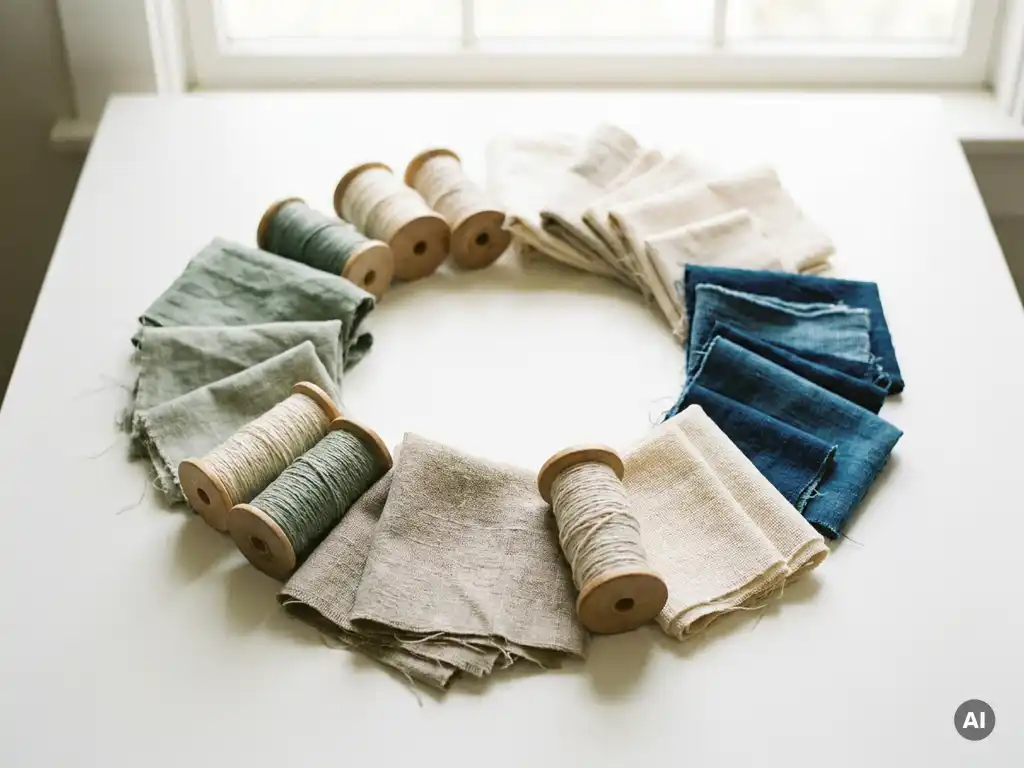
A circular economy in the textile industry means keeping textiles and raw materials in the economic cycle for as long as possible, rather than allowing them to end up as waste. Instead of the traditional path from production to disposal, a closed-loop system is created: materials are reused, repaired, refurbished, or recycled. This applies to all stages of the textile value chain, from raw material extraction to the final product. In this article, we answer the most important questions about sustainable textile production and circular processes.
How does the circular economy work in the textile industry?
The circular economy in the textile industry works by designing products from the outset so that their materials can be reintroduced into the production process after use. The goal is to conserve resources, prevent waste, and sustain the value of materials over the long term.
Specifically, this means that a T-shirt is no longer simply thrown away when it has reached the end of its useful life. Instead, it is collected, sorted, and either resold directly, processed into new fibers, or used as a raw material for other products. For this to work, textiles must be designed with recyclability in mind from the very beginning. For example, blended fabrics made from many different fibers are significantly harder to recycle than single-fiber materials.
The circular economy follows the principle of the so-called R strategies: Reduce, Reuse, Repair, Remanufacture, and Recycle. The higher up in this hierarchy a company starts, the more resources and energy are saved. Reuse is therefore more valuable than recycling, because recycling always results in a loss of energy and material quality.
What types of textile recycling are there?
There are three basic types of textile recycling: mechanical, chemical, and thermal recycling. They differ significantly in terms of method, outcome, and application.
Mechanical Recycling
In mechanical recycling, used textiles are physically shredded and broken down into new fibers, known as staple fibers. The process is well-established and cost-effective, but it produces shorter fibers of lower quality. Such fibers are well-suited for insulation materials, cleaning rags, or nonwoven fabrics, but have limited suitability for high-quality clothing.
Chemical Recycling
Chemical recycling breaks down textile fibers at the molecular level and recovers new feedstocks from them that can be comparable in quality to virgin raw materials. This process is particularly well-suited for polyester and cotton. The technology is still relatively new, but it is developing rapidly and is considered a key building block for a truly sustainable textile industry.
Thermal Recycling
In thermal recycling, textiles are incinerated to generate energy. This is the last option in the recycling hierarchy and is not considered true material recycling because the raw material is lost in the process. It is better than landfilling, but significantly less valuable than mechanical or chemical recycling.
What are the biggest challenges facing the circular economy in the textile industry?
The biggest challenges facing the circular economy in the textile sector are the collection and sorting of used textiles, the complexity of blended fabrics, and the lack of economic incentives for circular business models. In addition, many processes do not yet function on an industrial scale.
Specifically, the following obstacles are evident:
- Variety of Materials: Modern textiles often consist of many different fibers, coatings, and additives. This makes automated sorting and recycling difficult.
- Collection and Return: Consumers often do not return used textiles or throw them in the general waste. Effective take-back systems are still frequently lacking.
- Loss of quality: Recycled fibers often do not have the same quality as virgin materials. This limits their potential uses.
- Costs: Circular processes are often more expensive than production using new raw materials, as long as primary materials remain relatively inexpensive.
- Lack of data transparency: Throughout the supply chain, there is often a lack of information about which materials are used in a product, which makes recycling processes more difficult.
The last point, in particular, illustrates why digitalization is so important for the circular economy.
What role do digitalization and software play in the circular economy?
Digitalization and software play a central role in the circular economy of the textile industry because they provide transparency regarding materials, production processes, and supply chains. Without reliable data, it is nearly impossible to manage or improve circular processes.
Specifically, digital solutions help in several ways:
- Material Tracking: Digital systems track which raw materials and fibers were used in a product. This forms the basis for future recycling.
- Production Control: A Manufacturing Execution System helps reduce waste and use resources more efficiently.
- Operational Data Collection: Due to the Collection of Operational Data This makes it possible to identify energy consumption and material losses in production and reduce them in a targeted manner.
- Supply Chain Management: ERP systems connect all stages of the value chain and provide access to information about the origin of materials and processing steps.
- Business Intelligence: Analytics tools help identify patterns, such as where there is a particularly high amount of material waste or where return rates are low.
In short: Anyone who wants to seriously implement circular processes needs a solid digital database. Without it, the circular economy remains nothing more than a buzzword without an operational foundation.
What legal requirements apply to textile companies?
Textile companies in the EU are increasingly required to comply with legal requirements related to sustainability and the circular economy. Of particular relevance are the EU Ecodesign Regulation, extended producer responsibility, and the requirement for the separate collection of used textiles.
Starting in 2025, all EU member states will be required to collect textile waste separately. This means that municipalities and businesses will no longer be allowed to simply dispose of used textiles in the general waste stream. At the same time, the EU is working on an Ecodesign Regulation for textiles, which is intended to require that products be designed to be durable, repairable, and recyclable.
Added to this is the Corporate Sustainability Reporting Directive (CSRD), which requires larger companies to report transparently on their sustainability measures. The digital product passport, which stores information about a textile’s material composition and production process, will also become mandatory for an increasing number of product categories in the coming years. For textile companies, this means that requirements are increasing, and those who do not invest in data transparency and circular processes now will find it more difficult to meet these requirements later on.
How can textile companies implement circular processes in practice?
Textile companies can implement circular processes in a concrete way by taking action in four areas: product design, take-back and sorting, production processes, and digital infrastructure. The transition does not have to be complete right away, but it should begin in a structured manner.
Here are some practical starting points:
- Recyclable Design: Design products from the outset so that they are made from a single type of material and contain no adhesives or mixed fibers. This makes recycling much easier later on.
- Establishing take-back systems: Actively encourage customers to return used textiles, for example through return programs or partnerships with collection points.
- Making Material Flows Transparent: Identify which materials are used where and where waste is generated. That is the first step toward improvement.
- Using secondary raw materials: Integrate recycled fibers into production in a targeted manner, even if the proportion is small at first.
- Involving supply chain partners: A circular economy cannot function on its own. Suppliers, processors, and retailers must work together to find solutions.
It is important that circular processes not be treated as an additional task, but rather be integrated into existing workflows. This works best when the digital infrastructure provides the necessary data.
How update texware Supports Sustainable Textile Production
Here at update texware, we have been exclusively focused on software solutions for the textile industry for more than 40 years, and since 2025, we have been actively involved in projects related to textile recycling and the digitization of circular processes. We understand what textile companies need to implement the circular economy in their day-to-day operations.
Our solutions help you lay the groundwork for sustainable textile production:
- texware/ERP connects all stages of your value chain and provides transparency into material flows, from raw materials to shipping.
- texware/MES makes your production more efficient and helps reduce scrap and waste of resources.
- texware/Monitoring, It collects operational data in real time and shows where energy and materials can be saved.
- texware/DeepSee provides the analytics you need to quantify circular processes and continuously improve them.
If you would like to know how we can specifically support your company on its path toward a circular economy, Please contact us directly. We'll show you what's possible with the right digital tools.
Related Articles
- Can an MES system improve energy management in production?
- What are the benefits of AI in manufacturing?
- When Is Energy Management Worth It for Textile Manufacturing Facilities?
- Can AI-driven manufacturing reduce the scrap rate in the textile industry?
- How does AI help small textile businesses with digital transformation?