
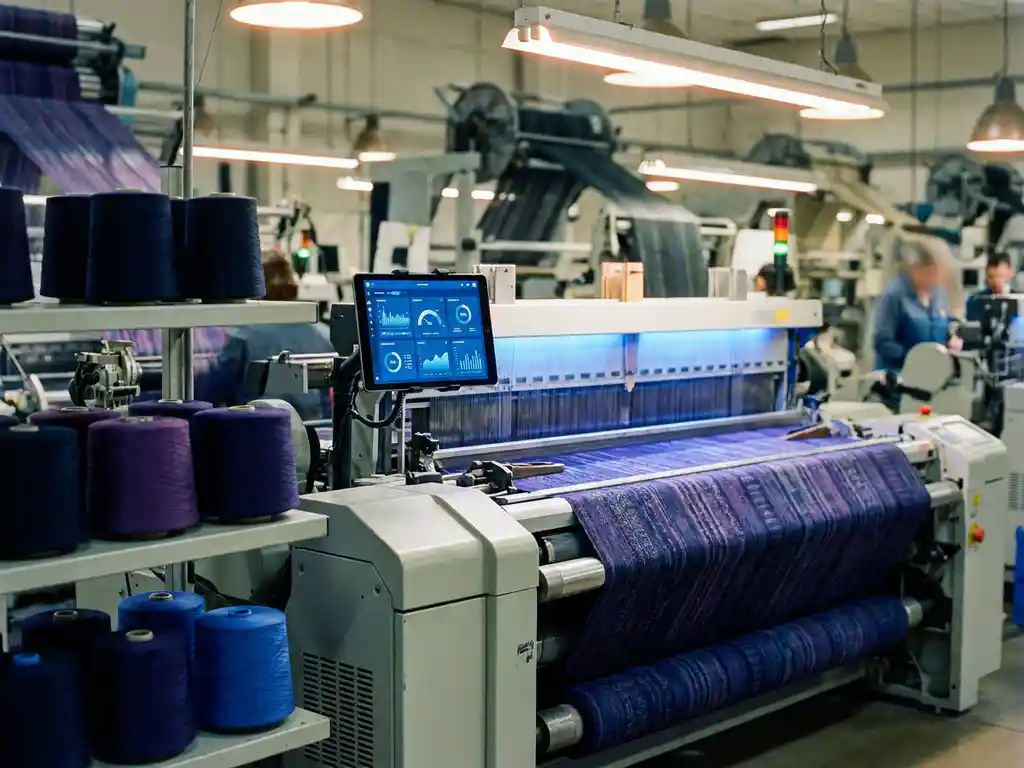
When it comes to implementing AI in textile manufacturing, medium-sized companies are best off starting where data is already available and manual processes are time-consuming—for example, in production planning, quality control, or material requirements planning. The best approach is to proceed step by step: start with a specific use case, then expand to other areas.
For SMEs in the textile industry, this means, in concrete terms: no complete system overhaul all at once, but rather a targeted pilot project that delivers measurable results quickly. The following sections answer the most important questions about getting started with AI in textile production.
What exactly can AI do in textile manufacturing?
In textile manufacturing, AI performs specific tasks such as automatic defect detection in fabrics, predictive maintenance of machines, optimization of production schedules, and forecasting material requirements. In doing so, it analyzes vast amounts of production data that no human could analyze manually at this speed.
In practical terms, AI helps in textile manufacturing primarily in the following areas:
- Quality Control: Camera systems with AI analysis detect web defects, color variations, or seam issues in real time before defective products are processed further.
- Production Planning: AI algorithms calculate optimal order sequences, take machine availability and delivery dates into account, and suggest adjustments when conditions change.
- Predictive Maintenance: Sensor data from looms, knitting machines, or finishing lines is analyzed to predict breakdowns before they occur.
- Material Requirements Planning: AI-powered forecasts help ensure that yarns, ingredients, and auxiliary materials are ordered according to demand without incurring excessive inventory costs.
- Order Management: Patterns in customer orders are identified, seasonal fluctuations are anticipated, and delivery dates are calculated more realistically.
It is important to note that AI does not replace skilled workers; rather, it provides them with better information to help them make faster decisions.
What are the prerequisites for an SME to get started with AI?
An SME in the textile manufacturing industry needs three things above all else to get started with AI: structured data from production, a basic digital infrastructure such as an ERP system or an MES solution, and clear processes that can be digitized. Without a data foundation, AI cannot deliver meaningful results.
Specifically, the following requirements should be met:
- Digital database: Production volumes, machine operating times, scrap rates, and order data must be recorded digitally, not just on paper or in spreadsheets.
- Basic IT Infrastructure: A fully functional ERP system that integrates orders, materials management, and production data is the foundation for any AI application.
- Internal On-Call Duty: Employees need to understand what AI can and cannot do. Training and open communication are just as important here as the technology itself.
- Clear use case: Anyone who starts using AI without identifying a specific problem will quickly waste time and money. A specific pain point—such as high scrap rates—is the best place to start.
Many textile companies underestimate the potential that already lies within their existing data. Anyone who ERP System for the Textile Industry Organizations that use it often already have a solid data foundation for initial AI applications.
Where should AI be implemented first in the textile manufacturing industry?
In textile manufacturing, companies should start by using AI in quality control or production planning, because the benefits become apparent quickly in those areas and the data is usually already available. These areas deliver measurable results within a few months and build trust in the technology.
Quality control is particularly well-suited as a starting point because scrap and rework have a direct impact on costs in the textile industry. An AI-powered camera system that detects fabric defects can often be launched as a pilot project without requiring extensive system integration.
Production planning is the second recommended area to start with: Many SMEs still rely on manual planning processes or simple spreadsheets. AI-powered planning tools that are directly integrated with the ERP system help optimize order sequencing and identify bottlenecks earlier.
What to avoid: starting with too broad an approach. If you try to automate quality control, predictive maintenance, and customer forecasting all at once, you’ll overwhelm your organization and lose sight of the actual benefits.
How do you integrate AI tools into an existing textile ERP system?
AI tools can be integrated into an existing textile ERP system via interfaces (APIs) that exchange data between the ERP and the AI application. Modern ERP systems offer standardized connectors that allow external AI modules to be integrated without modifying the core system.
The typical integration process works like this:
- Clarify data requirements: What data does the AI tool need? Production volumes, machine data, order data? This data must be available in a structured format in the ERP system.
- Check interfaces: The ERP provider should clarify which APIs or export formats are available and how up-to-date the data can be when it is transferred.
- Set up pilot integration: First, connect the AI tool to a limited dataset and test it before putting it into live operation.
- Restore results: AI recommendations, such as optimized production schedules, should be visible directly in the ERP system so that employees can use them without having to switch systems.
- Continuous Monitoring: Regularly check the quality of the AI output and retrain the model as needed.
Important: An AI tool that runs separately from the ERP system and must be manually populated with data creates more work than it saves. Integration should be automated as much as possible.
What are realistic estimates for the costs and time required?
For a medium-sized textile company, realistic investment costs for an initial AI pilot range from a few thousand to a few tens of thousands of euros, depending on the use case and the effort required for integration. The time required for an initial pilot is typically three to six months.
The costs generally consist of the following components:
- Software and Licenses: Many AI tools are offered as SaaS solutions, with monthly usage fees instead of high one-time costs.
- Integration effort: Integration with the ERP system and data preparation are often the biggest cost factors, especially when the data was previously unstructured.
- Internal Resources: Employees need time for training, pilot project support, and testing the results. This is not an effort that should be underestimated.
- Consulting and Implementation: An experienced partner who is familiar with both textile processes and the software used can save you time and prevent failed attempts in the long run.
Realistically, if you start with a clearly defined pilot project, you can see initial results within six months and then decide whether and how to proceed with expansion.
How do you measure the success of AI in textile production?
The success of AI in textile production is measured using specific, predefined metrics: scrap rate, machine availability, planning accuracy, lead times, or inventory costs. Without predefined benchmarks, it is not possible to draw any meaningful conclusions.
Proven metrics for measuring success include:
- Rejection rate: Has the percentage of defective goods decreased since the introduction of AI-based quality control?
- On-time delivery: Have more orders been delivered on time since production planning has been AI-driven?
- Machine Availability: Does predictive maintenance result in fewer unplanned downtimes?
- Inventory Turnover: Has material requirements planning improved, thereby reducing tied-up inventory?
- Planning effort: How many hours do planners still spend manually on tasks that used to take significantly more time?
It is important to collect these metrics before the pilot begins so that a true before-and-after comparison is possible. AI projects that launch without a baseline will have a hard time demonstrating their value later on, which makes it difficult to gain internal buy-in and secure budget approval for further steps.
How update texware Helps Textile Manufacturers Get Started with AI
Here at update texware, we know that the transition to AI-driven manufacturing for textile companies must be concrete and practical, not abstract. That’s why our portfolio provides exactly the foundation on which AI applications can be meaningfully built:
- texware/ERP provides the structured data from order management, materials management, and production planning that AI tools need to deliver useful results.
- texware/MES It collects production data in real time directly at the machine, thereby laying the foundation for quality control and predictive maintenance.
- texware/Monitoring, As a digitalization platform, it links machine data and operational data and makes them available for further analysis and AI applications.
- texware/DeepSee brings business intelligence directly into the system, allowing AI results and key metrics to be analyzed immediately.
- Our consultants come from the textile industry and are familiar with the processes ranging from yarn production to garment manufacturing and on to Textile Retail From personal experience.
Whether you're just starting your digital transformation or already have an ERP system in place and are ready to take the next step, we'll support you every step of the way—from the initial analysis to go-live. Please contact us and let's work together to find out where AI can have the fastest impact on your textile production.
Related Articles
- How does the water footprint affect sustainability in textile production?
- How does AI reduce errors in textile order processing?
- When Is Energy Monitoring Worth It for Small Textile Companies?
- What data is needed for predictive maintenance on textile machines?
- Can energy monitoring extend the service life of machinery in a textile plant?