
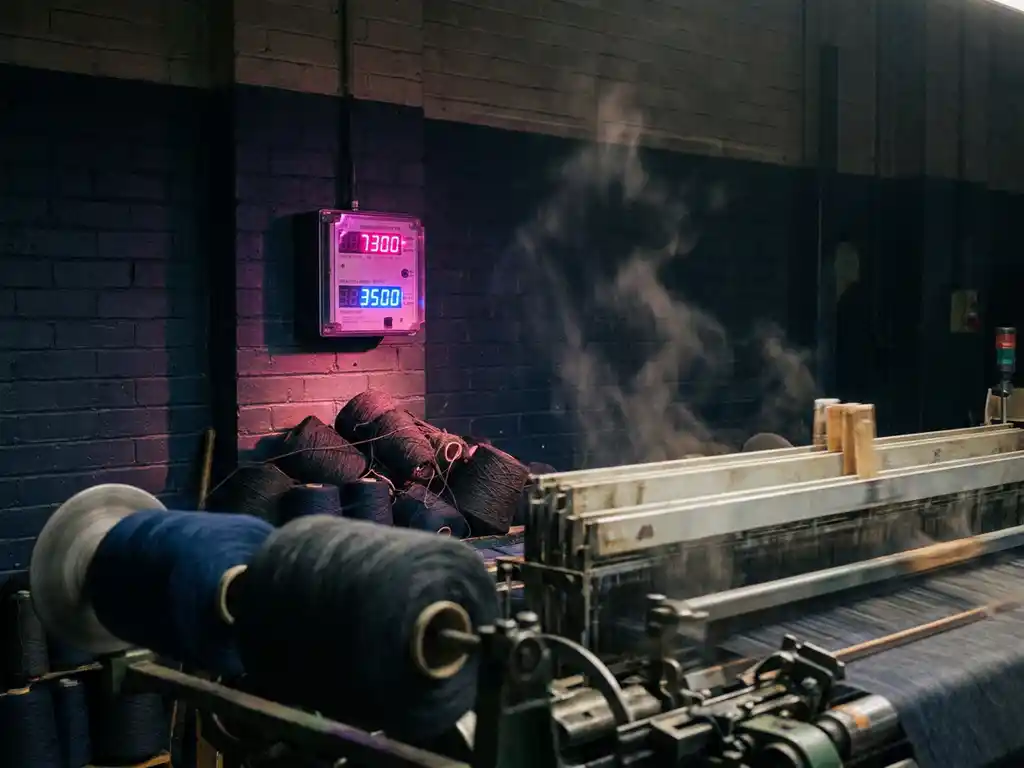
Hidden energy waste in textile production can be identified by paying close attention to unusual consumption patterns, unplanned downtime, and inefficient machine operating times. Often, the greatest losses aren’t found in obvious weak points, but in insidious processes that remain invisible in day-to-day operations. The following questions show exactly where you should start and how you can systematically reduce energy costs in your textile operation.
Where do the greatest energy losses occur in textile production?
The greatest energy losses in textile production typically occur in thermal processes such as drying, setting, and finishing; in the compressed air supply; and in machines that are idling or poorly maintained. Together, these areas account for the majority of unnecessary energy consumption in a textile plant.
Wet finishing—that is, dyeing, washing, and coating—is among the most energy-intensive stages of the textile value chain. In this process, water is heated, kept under pressure, and then cooled again. If these processes are not precisely coordinated, a significant portion of the energy used is simply wasted.
The compressed air supply is also a frequently underestimated cost driver. Leaks in pipes, incorrectly sized compressors, or excessively high system pressure result in energy being generated that never reaches its intended destination. Added to this are outdated drive systems that do not use variable-speed motors, even though the load conditions fluctuate significantly.
In the apparel manufacturing and textile retail sectors, the losses are different: Here, the main costs stem from air conditioning, lighting, and the operation of conveyor systems, which continue to run even when production is not taking place.
Which metrics reveal hidden energy consumption?
Hidden energy consumption is primarily reflected in three metrics: specific energy consumption per unit produced, base load outside of production hours, and the ratio of peak load to average load. By regularly analyzing these metrics, you can identify anomalies before they show up on your electricity bill.
Specific energy consumption—that is, kilowatt-hours per kilogram of yarn, per meter of fabric, or per unit produced—is the most meaningful indicator of energy efficiency in textile production. If this value increases without any changes in production parameters, it is a clear sign of creeping losses, such as those caused by worn-out machine parts or changes in raw material properties.
The base load outside of operating hours reveals which loads are not being shut off, even though they could be. In many textile factories, compressors, ventilation systems, or lighting systems run around the clock because no one has actively checked whether this is necessary.
The ratio of peak load to average load is an indication of poorly planned production processes. When many machines start up at the same time, peak loads occur, which increase energy costs and place a strain on the grid. A more even distribution of load throughout the day not only reduces costs but also extends the life of the equipment.
How does production data collection help identify energy losses?
Operational data collection helps identify energy losses by consolidating machine data, consumption figures, and production volumes in real time and making them analyzable. Only when this data is systematically collected can patterns be identified that remain hidden in day-to-day manual operations.
Without a structured Operational Data Collection in the Textile Industry Energy consumption remains a black box. You know what’s on the annual statement, but you don’t know which machine, shift, or process step is responsible for it. A digital data collection solution can make these relationships visible.
Specifically, here’s how it works: Sensors on machines and supply lines continuously measure electricity, heat, compressed air, and water. This raw data is linked to production data—that is, order volumes, machine runtime, and shift schedules. This generates key metrics that show whether one machine consumes more energy than another of the same model, whether certain shifts operate more efficiently than others, or whether a process suddenly requires more energy after maintenance than it did before.
The ability to set alerts is particularly valuable: If the consumption of a machine exceeds a defined threshold, an alert is automatically triggered. This allows textile companies to respond to anomalies before a small problem turns into a major cost factor.
What are some typical warning signs of inefficient production processes?
Typical warning signs of inefficient production processes in the textile industry include rising energy costs coupled with stable or declining output, frequent unplanned machine downtime, high scrap rates, and conspicuously high compressed air consumption for no apparent reason.
Rising energy costs while production remains constant are the most obvious sign. If consumption increases without a corresponding increase in production, energy is being wasted somewhere in the process—whether due to heat loss, mechanical wear, or inefficient control systems.
Unplanned downtime is also a strong warning sign. Machines that break down frequently consume a disproportionately large amount of energy when restarting. In addition, idle consumption often occurs during downtime because peripheral equipment, such as exhaust systems or cooling systems, continues to run even though the main machine is shut down.
High scrap rates are an indirect but important indicator: Every defective product that is reworked or discarded has consumed energy without contributing to revenue. Reducing scrap automatically lowers specific energy consumption.
Another warning sign is compressed air consumption that does not match production volume. Compressed air is one of the most expensive forms of energy in production. Leaks in pipes, leaky couplings, or oversized nozzles cause a significant portion of the compressed air generated to escape unused into the atmosphere.
When is a systematic energy analysis worthwhile for textile companies?
A systematic energy analysis is worthwhile for textile companies whenever the share of energy costs in total costs rises significantly, when investments in new machinery or processes are planned, or when a company wants to specifically measure and demonstrate its sustainability goals.
For small and medium-sized textile companies, the timing is particularly favorable when a digitalization initiative is already underway. Companies that begin systematically collecting production data can directly track and analyze their energy consumption without significant additional effort.
An energy analysis is also a good idea before making major investments. It shows whether a new machine will actually deliver the expected savings, or whether losses elsewhere in the process will offset those savings. A solid data foundation makes such decisions more transparent and reliable.
In the Textile industry The issue of energy is also gaining importance due to regulatory requirements. Sustainability reporting and supply chain transparency increasingly call for specific consumption data. Companies that already collect this data are not only more efficient but also better prepared for future requirements.
How can we reduce energy waste in the long term?
Energy waste in textile production can be reduced on a long-term basis by continuously tracking consumption data, regularly analyzing key performance indicators, encouraging employees to adopt energy-conscious behaviors, and gradually implementing technical improvements. One-time measures are not enough; a systematic process is essential.
The first step is always transparency: Without data, there can be no improvement. If you know where energy is being lost, you can take targeted action. The second step is prioritization: Not every measure has the same effect. It’s worth optimizing the largest energy consumers first—that is, thermal processes, compressors, and drives.
From a technical standpoint, the following measures are recommended:
- Use of Speed-Controlled Drives in Pumps, Fans, and Compressors
- Heat Recovery from Wastewater and Exhaust Air in Wet Finishing
- Leak Testing and Pressure Optimization in Compressed Air Systems
- Shutting Down Peripheral Devices During Downtime Through Automatic Control
- Regular maintenance of heat exchangers, filters, and gaskets
The organizational aspect is just as important: shift handoffs should include energy consumption as a standard item. Employees who understand why certain measures are important implement them more reliably than those who simply follow instructions.
How update texware helps identify energy waste in textile production
At update texware, we know that energy efficiency isn't an abstract goal, but rather a concrete result of a solid data foundation and well-designed processes. That's exactly why we developed our solutions.
With texware/Monitoring,, our production data collection and digitization platform, allows you to collect machine data, consumption figures, and production volumes in real time. This lets you see at a glance where energy is being wasted and which processes need optimization. In addition, texware/MES the ability to manage production processes in a way that avoids peak loads and makes optimal use of machine uptime.
What sets us apart from generic software providers: Our consultants and programmers have firsthand experience with the textile value chain. You don’t have to explain to us how your production works. We already know.
Specifically, we'll help you with the following:
- To track energy consumption per machine, shift, and job
- To automatically calculate key metrics such as specific energy consumption per unit produced
- Detecting anomalies early and triggering alerts
- Provide consumption data for sustainability reports and supply chain transparency
- Integrate additional modules, such as texware/DeepSee for business intelligence, step by step
If you'd like to know how much potential your business has, please contact us. Get in touch now and let's work together to identify where your energy costs can be reduced.
Related Articles
- What metrics measure the success of sustainable textile production?
- How can AI reduce energy consumption in textile factories?
- How does energy monitoring reduce production costs in textile companies?
- How do you get started with AI-driven manufacturing in a medium-sized textile company?
- Can AI-driven manufacturing reduce the scrap rate in the textile industry?