
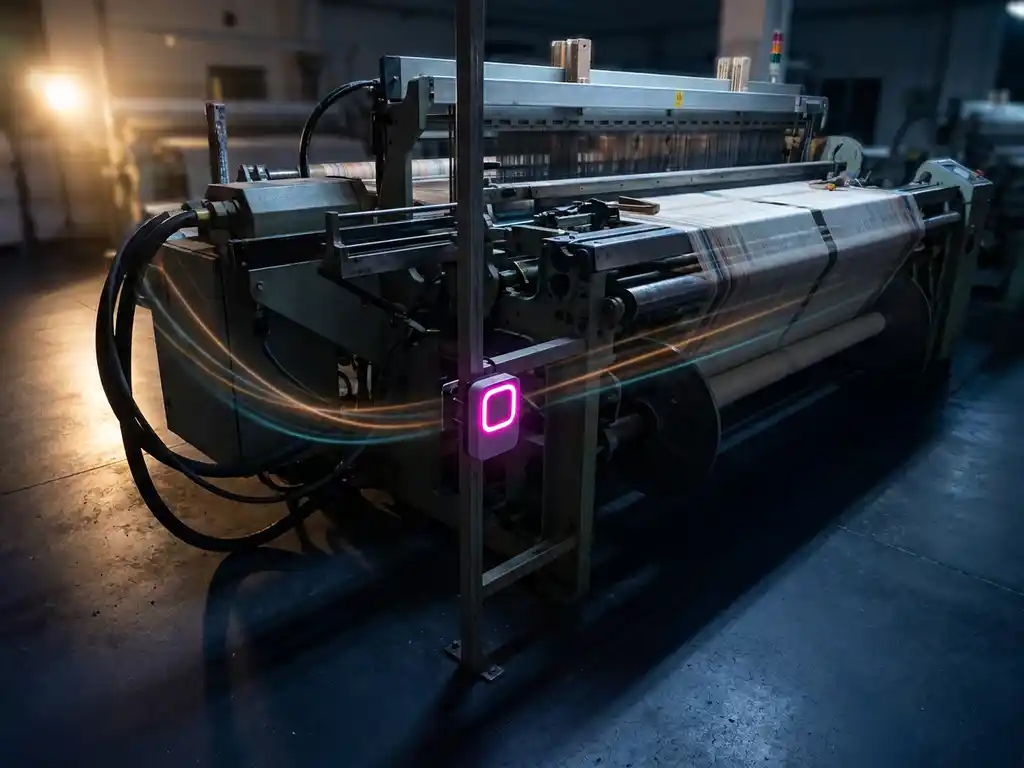
Yes, energy monitoring can extend the service life of machinery in textile plants. By continuously monitoring the power consumption of individual machines, companies can often detect wear and malfunctions weeks before a breakdown occurs. This gives companies the opportunity to take targeted action before damage occurs. The following sections answer the most important questions about energy monitoring and predictive maintenance in the textile industry.
How does a machine's energy consumption reveal its condition?
A textile machine’s energy consumption is a direct reflection of its condition. A machine that draws more power than usual is operating against resistance: dull blades, poorly lubricated bearings, clogged filters, or mechanical misalignments. Conversely, a sudden drop in power consumption may indicate a partial failure or idling.
The basic idea is simple: Every machine has a characteristic power consumption profile for normal operation. If the measured value deviates from this profile—either gradually or suddenly—something is wrong. This principle applies regardless of whether the machine is a weaving machine, a knitting machine, or a finishing machine. The current signal provides continuous information without requiring anyone to physically inspect the machine.
This is particularly useful for machines that run around the clock. In such cases, it is virtually impossible to perform a manual visual inspection while the machine is in operation. Energy consumption, on the other hand, can be tracked automatically and in real time.
Specifically, what does energy monitoring measure on textile machines?
Energy monitoring on textile machines typically measures active power consumption in kilowatts, reactive power, peak loads, and load fluctuations, as well as operating hours under load. These measurements are recorded at short intervals and analyzed over time.
Several relevant pieces of information can be derived from this:
- Trend Deviations: If fuel consumption rises slowly over a period of weeks, this indicates gradual wear and tear.
- Peak loads: Unusual load spikes may indicate mechanical jams or startup problems.
- Idle times: Machines that are running but not producing incur unnecessary costs.
- Shift Comparisons: Differences in consumption between shifts may indicate operator errors or different settings.
Modern systems link this raw data with production data, so that consumption is always viewed in relation to the actual quantity produced. This makes comparisons between different machines or production runs more meaningful.
How does energy monitoring differ from traditional maintenance?
Traditional maintenance follows a fixed schedule: Lubrication is performed after 500 operating hours, and wear parts are inspected after six months, regardless of whether the machine is actually experiencing problems. Energy monitoring, on the other hand, responds to the machine’s actual condition, not to a calendar.
That is the key difference between preventive and condition-based maintenance. Time-based maintenance is often either too early (and therefore costly) or too late (and therefore risky). Condition-based maintenance through energy monitoring allows you to take action exactly when it is needed.
Another difference lies in knowledge building: Energy monitoring generates a database over time that can be used to identify patterns. Which machine wears out faster? Which shift puts more strain on the equipment? These questions can be answered using historical consumption data, but not with a maintenance schedule.
Traditional maintenance remains important nonetheless; it is supplemented by energy monitoring, not replaced by it. The combination of both approaches is essential for the textile production particularly effective.
When Is Energy Monitoring Worth It for Small Textile Businesses?
Energy monitoring is worthwhile for small textile manufacturers as soon as unplanned machine downtime regularly causes production interruptions or when energy costs account for a significant portion of total costs. This applies to most textile manufacturers with as few as a handful of machines.
Specifically, it makes sense to get started if at least one of the following situations applies:
- Machine breakdowns happen unexpectedly and cause delivery delays.
- Repair costs are rising, and it's not clear why.
- The energy bill is high, but we don't have a clear picture of which machine uses how much energy.
- Maintenance intervals are based solely on the manufacturer's recommendations, not on the actual condition of the machine.
You don’t have to start by covering your entire machine fleet. Many companies begin with two or three critical machines—the ones whose failure would cause the most damage. This keeps the effort manageable, and the benefits become apparent quickly.
How is energy monitoring integrated into a textile ERP system?
Energy monitoring is integrated into a textile ERP system by automatically transmitting consumption data from sensors or electricity meters to the ERP system. There, the data is linked to production and order data, so that energy consumption is always visible in the context of ongoing production.
Technically, this is handled via interfaces between the monitoring system and the ERP. The sensors record measurements at short intervals; a gateway transmits this data to the software, and the ERP displays it in dashboards. Maintenance notifications or threshold alarms can be configured directly in the ERP system.
The practical advantage: Production planners can see not only how much is being produced, but also how efficiently the machines are operating. If a weaving machine suddenly requires more energy to produce the same number of units as it did the previous week, this appears immediately in the system. This enables a quick response without anyone having to manually compare spreadsheets. Anyone looking for an overview of possible Software Products for the Textile Industry will find various approaches to such integration there.
Which types of machines benefit most from energy monitoring?
Machines that operate under continuous heavy loads, have complex drive systems, or incur high repair costs benefit the most. In the textile industry, these primarily include weaving machines, knitting machines, finishing equipment, spinning machines, and drying units.
Weaving Machines and Knitting Machines
These machines often operate in multiple shifts and have many moving parts that are subject to wear. Weft insertion systems, needle plates, and drive motors often show signs of wear first in their energy consumption before it becomes mechanically apparent. Energy monitoring helps plan maintenance windows without having to wait for a breakdown.
Finishing systems and drying units
Energy consumption is particularly high here because heat must be generated. At the same time, deviations in consumption are a reliable indicator of problems: clogged nozzles, defective heating elements, or poor thermal insulation are immediately reflected in the measured values. For these systems, predictive maintenance through energy monitoring can save significant energy costs while also preventing quality issues.
How update texware Helps with Energy Monitoring in the Textile Industry
Here at update texware, we have specialized exclusively in software solutions for the textile industry for more than 40 years. Energy monitoring and predictive maintenance for textile machinery are an integral part of our solution portfolio because we know how important machine availability is in textile production.
Specifically, we support you with the following solutions:
- texware/Monitoring: Our production data collection and digitization platform captures machine data in real time and provides immediate visibility into energy consumption, operating times, and deviations.
- texware/MES: The Manufacturing Execution System links production data with machine data, so that maintenance needs can always be assessed in the context of current orders.
- texware/ERP: Our modular ERP system integrates all data from production, energy, and maintenance into a single system, eliminating the need to manage multiple siloed solutions.
- texware/DeepSee: With our business intelligence tool, you can analyze consumption trends over time and identify patterns before they become problems.
You don't need to explain to us how a loom works or why downtime in garment manufacturing is particularly costly. Our team comes from the industry and understands your needs. If you'd like to know how we can help you get started with energy monitoring and predictive maintenance, Please feel free to contact us.
Related Articles
- How does AI improve production planning in textile companies?
- What is the difference between AI-driven manufacturing and traditional production planning?
- How can AI-powered manufacturing be integrated into existing ERP systems?
- How do you get started with energy monitoring in textile production?
- How can electricity consumption be reduced in a textile manufacturing facility?