
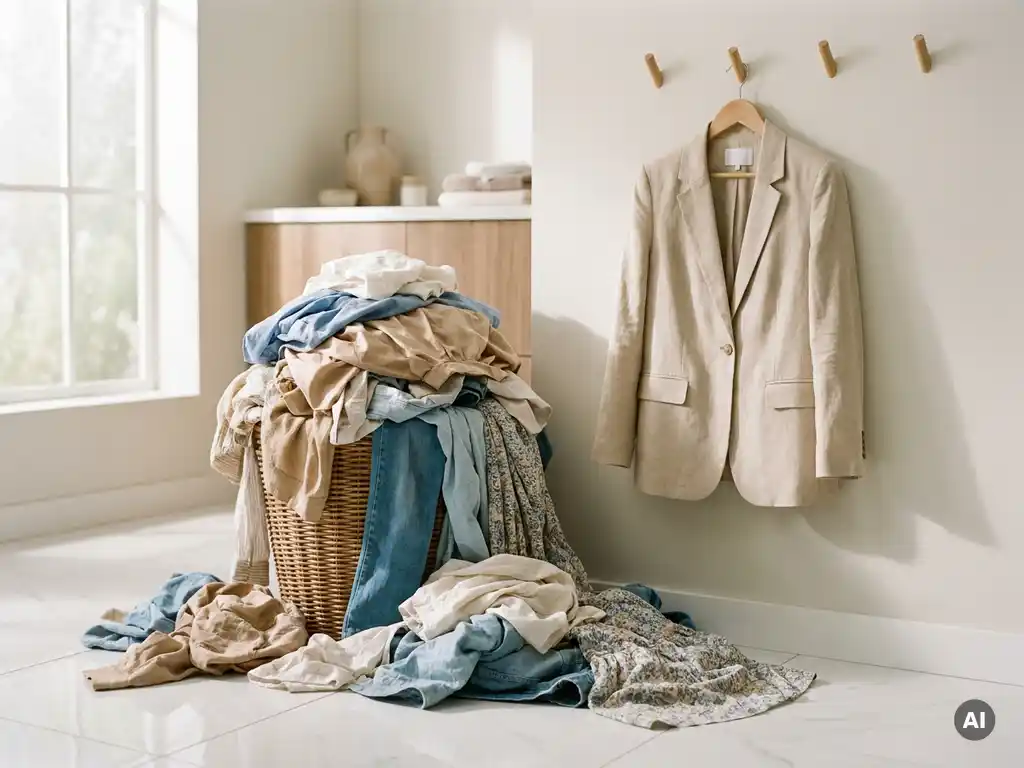
Let’s start with the most important answer: Our consumption habits prevent a functioning circular economy for textiles, primarily because we buy too much, throw things away too quickly, and pay too little attention to quality and repairability. Cheap fast-fashion products made from blended fibers are nearly impossible to recycle, often end up in household trash, and put a strain on the entire supply chain. In this article, we’ll walk you through the most important questions regarding consumer behavior, textile recycling, and sustainable fashion, step by step.
Why do so many pieces of clothing end up in the trash instead of being recycled?
The main reason is quite simple: Most people don’t know what to do with old clothes, and throwing them in the regular trash is the easiest option. Studies from across Europe show that a significant proportion of worn-out textiles is disposed of in household trash, even though effective collection systems exist. Convenience trumps awareness when there is no easy alternative.
On top of that, many items of clothing are thrown away in a condition that makes them unsuitable for either resale or recycling: stained, torn, or so worn out that even charitable organizations refuse to accept them. This is a direct consequence of fast fashion, where quality plays no role from the very beginning. Anyone who buys a T-shirt for five euros subconsciously expects it to fall apart quickly.
Another problem: Many consumers mix clothing with other waste because they don’t know that textiles should be collected separately. A lack of education and confusing disposal options contribute to valuable raw materials being lost before they even reach the recycling system.
How does fast fashion prevent a functioning circular economy?
Fast fashion undermines the circular economy for textiles on several levels at once: It produces too much, too cheaply, and from materials that are unsuitable for recycling. The business model relies on consumers constantly buying new items, which short-circuits the cycle from the outset.
The core problem lies in the material composition. Many fast-fashion products are made of blended fabrics—such as polyester-cotton blends—which are difficult or impossible to separate into their original components using current technology. What cannot be separated cannot be recycled effectively. At best, the material re-enters the economy as low-quality cleaning rags or insulation; at worst, it ends up in an incinerator.
Added to this is the sheer volume: The fashion industry produces more clothing annually than the market can absorb in the long term. Overproduction means that even unworn merchandise is destroyed. Collection bins and recycling systems are simply not designed to handle these volumes. Sustainable fashion, on the other hand, relies on durable materials, transparent supply chains, and a design philosophy that takes future recycling into account from the very beginning.
What really happens to clothes that end up in donation bins?
Clothing from collection bins goes through a multi-step sorting process. Some of it is resold as secondhand goods, some is sent to developing countries, and only a small portion is actually recycled into new textile fibers. The rest ends up as cleaning rags, insulation material, or in incinerators.
The reality behind the recycling bin is more complex than many people realize. Sorting companies first separate items based on quality and condition. Items in good condition are sent to the secondhand market, either in Europe or to countries such as Ghana or Pakistan, where used clothing from the West has been causing market distortions for years. Damaged or heavily soiled clothing is processed further or incinerated.
Textile recycling itself—that is, the processing of fibers into new yarns—is still in its infancy from a technological standpoint. The infrastructure is lacking, sorting capacities are limited, and the quality of the collected materials is often too low for high-quality fiber recycling. So while anyone who thinks they’ve fulfilled their environmental duty by tossing something into a recycling bin isn’t entirely wrong, they should know that the path clothing takes from there is anything but straightforward.
What consumer habits make textile recycling technically difficult?
Certain purchasing decisions make textile recycling technically nearly impossible. These include buying mixed-fiber items, preferring clothing with many additional components such as zippers, buttons, or appliqués, and washing with fabric softener, which chemically alters the fibers.
Specifically, the following consumer habits make recycling more difficult:
- Buy blended fibers: Polyester-cotton or spandex components in stretch fabrics are virtually impossible to separate chemically.
- Clothing with many additional pieces: Rivets, buttons, zippers, and patches must be removed by hand before recycling, which makes the process expensive and time-consuming.
- Coated or laminated materials: Today, functional jackets made with membranes or coated fabrics are hardly suitable for fiber recycling.
- Drop off damaged clothing: Heavily soiled or damp clothing contaminates entire sorting batches.
- Small quantities in large numbers: People who buy ten cheap T-shirts instead of two high-quality ones generate more waste while using less material per item.
None of these habits stem from malicious intent, but rather from the fact that the pricing system creates the wrong incentives. As long as blended-fiber shirts are cheaper than pure natural products, consumers are tempted to buy products that are difficult to recycle.
Should you repair clothes or just buy new ones?
In most cases, repairing is the more environmentally responsible choice. Manufacturing a new garment consumes significantly more resources than repairing an existing one, even when you factor in the transportation and material costs of the repair. Repairing extends the product’s life cycle and reduces the burden on the recycling system.
Of course, the decision depends on the individual case. A high-quality wool jacket that has come apart at the seam is definitely worth repairing. A fast-fashion shirt made of thin polyester that stretches out after ten washes, on the other hand, is not worth repairing because the material itself isn’t designed to last. This highlights the fundamental problem: Cheap clothing is often designed in such a way that it cannot be repaired.
In many European countries, repair cafés, government-supported repair initiatives, and platforms for secondhand fashion are springing up, making it easier to re-embrace a culture of repair. Those who buy clothing with repairability in mind—that is, by looking for simple seams, replaceable buttons, and durable materials—are making a choice that impacts the entire system of Sustainability in the Textile Industry advances.
How can digital processes improve the circular economy in the textile industry?
Digital processes improve the circular economy in the textile industry by creating transparency regarding materials, production methods, and the flow of goods. When companies throughout the textile supply chain know what is being produced where and what it is made of, recycling systems can operate in a more targeted and efficient manner.
Specifically, digital solutions help in several ways:
- Material Traceability: Digital product passports that document the type of fiber, origin, and processing steps enable recyclers to correctly identify and sort materials.
- Production Planning: Avoiding overproduction automatically reduces textile waste. ERP Systems for Textile Companies help plan demand more accurately and optimize inventory.
- Operational Data Collection: By collecting machine data and process parameters, it is possible to significantly reduce scrap and material losses in production.
- Supply Chain Integration: Digital platforms connect suppliers, manufacturers, and retailers in a way that allows take-back and recycling systems to be seamlessly integrated into the flow of goods.
Digitalization is not a panacea, but it creates the data foundation without which a true circular economy cannot function. If you don’t know what’s in a product, you can’t recycle it effectively. And if you don’t know how much you’re producing, you can’t prevent overproduction. Digital transparency is therefore one of the most important prerequisites for a functioning circular economy for textiles.
How update texware Supports the Textile Circular Economy
Here at update texware, we have been exclusively focused on software solutions for the textile industry for more than 40 years. Since 2026, we have been actively involved in projects related to textile recycling and the digitization of circular processes. Our solutions specifically help textile companies lay the groundwork for a functioning circular economy:
- texware/ERP It integrates all areas of the business, from materials management to shipping, and enables precise production planning that reduces overproduction and waste.
- texware/MES manages production in real time and helps minimize scrap and material loss.
- texware/Monitoring, It collects operational data and provides the digital transparency required for product passports and material traceability.
- texware/DeepSee provides business intelligence reports that enable companies to analyze inventory, consumption, and waste volumes in a targeted manner.
If you'd like to learn how digital processes can help your company move toward sustainable textile production, please contact us. On our Website You can find an overview of our entire portfolio, or you can go directly to Contact us at and we'll work with you to determine which solution best meets your needs.
Related Articles
- What is AI-powered textile production, and how does it work?
- How does AI improve production planning in textile companies?
- How does predictive maintenance work for textile machines?
- When Is Energy Management Worth It for Textile Manufacturing Facilities?
- How does AI help small textile businesses with digital transformation?