
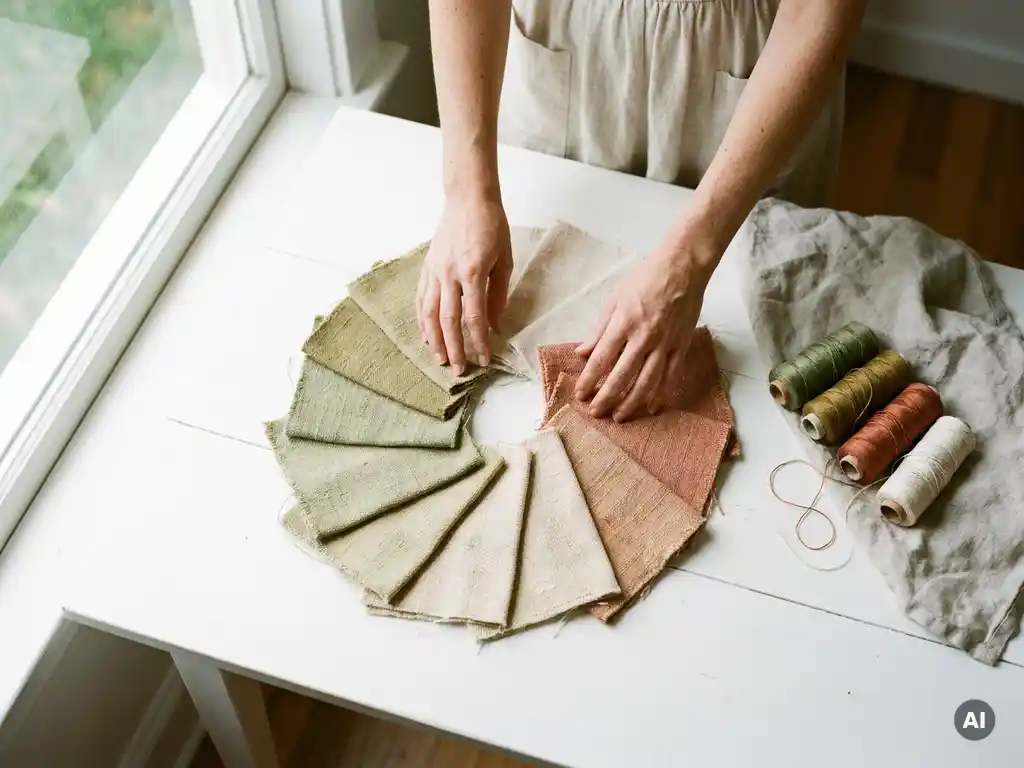
Textile design plays a central role in the circular economy because the design phase determines whether a garment can later be recycled, reused, or repaired. According to industry estimates, up to 80 percent of a product’s environmental impact is determined during the design phase. The following sections explore the most important issues surrounding sustainable textile design and circular production.
How does textile design affect the recyclability of clothing?
Textile design directly influences the recyclability of clothing because the choice of materials, construction, and finishing determine whether a garment can be sorted by material type and recycled at the end of its life. A sweater made of pure cotton is significantly easier to recycle than a blended garment made of cotton and polyester that has been finished with metal rivets and adhesive seams.
Specifically, this means that every design decision has consequences for the textile value chain. Seams, coatings, dyes, and additives can complicate or even prevent the recycling process. Designing clothing so that its components can be easily separated lays the groundwork for a functioning circular economy.
So-called composite materials are particularly problematic: When foam padding is bonded to fabric or spandex is permanently woven into the base fabric, the material ultimately loses its value as a raw material. Good design, therefore, thinks from the end—that is, from the recycling process back to the first sketch.
What are the principles of circular textile design?
Circular textile design is based on the principle that materials should remain in the cycle for as long as possible. The key principles are durability, reparability, the separability of components, and the use of materials that can be safely recycled at the end of their life cycle, whether through biological or technical means.
In practice, these principles can be applied to specific design decisions:
- Designed for Durability: Sturdy seams, high-quality materials, and timeless designs significantly extend the product's lifespan.
- Design for Repairability: Standardized fasteners, interchangeable components, and easily accessible seams make repairs possible.
- Design for Separability: Buttons, zippers, and labels are attached in such a way that they can be easily removed before recycling.
- Design for Closing the Loop: Materials are selected so that, after use, they are either compostable or serve as high-quality secondary raw materials.
These principles are not merely theoretical ideals; they can already be applied in production today when designers and manufacturers collaborate early on.
Which materials are best suited for recyclable textiles?
Single-fiber natural fibers such as cotton, wool, or linen, as well as single-fiber synthetic fibers such as polyester or nylon, are best suited for recyclable textiles, provided they are not mixed with other materials. What matters is that the fibers are of a single type, not whether a fiber is natural or synthetic.
Natural fibers have the advantage of being biodegradable under the right conditions. Wool and cotton can be composted if they do not contain any chemical finishes or synthetic additives. Synthetic fibers such as polyester, on the other hand, can be converted back into new fibers through chemical or mechanical recycling, but only if they are sorted by type.
Blended fabrics—such as a 60-to-40 polyester-cotton blend—pose a problem. These blends cannot be composted or efficiently recycled because separating the fibers is technically complex and often not economically viable. Innovative materials such as Lyocell (Tencel) or bio-based synthetic fibers offer new possibilities here because they were developed to be recyclable.
How does digitalization support circular textile design?
Digitalization supports circular textile design by creating transparency regarding materials, processes, and product life cycles. Digital product passports, real-time production data, and connected systems make it possible to make design decisions based on comprehensive information and to actively manage circular processes.
Specifically, digitalization helps in several ways:
- Material Traceability: Digital systems track which fibers, colors, and additives are contained in a product. This provides an important foundation for recycling companies.
- Production Control: Connected MES Systems help reduce waste and use resources more efficiently.
- Life Cycle Analysis: Software-based analyses identify where in the supply chain the greatest environmental impacts occur, enabling designers to take targeted action to mitigate them.
- Digital Product Passport: Starting in 2026, the EU will gradually require manufacturers to provide product information digitally. This will create the infrastructure for a true circular economy.
Anyone who is in the Clothing Production Companies that rely on digital processes can also respond more quickly to new requirements, whether due to changes in material specifications or new recycling technologies.
What challenges does circular design face in the textile industry?
The biggest challenges for circular design in the textile industry are economic incentives, a lack of infrastructure, and a lack of standardization. Circular products are often more expensive to develop and produce, while the market does not always compensate for these additional costs.
Economic and Structural Barriers
Fast fashion puts manufacturers under cost pressure, making recyclable materials and more complex designs economically unattractive. Replacing inexpensive blended fabrics with high-quality solid-color fabrics increases material usage and, consequently, costs. Without corresponding demand or regulatory requirements, there is no incentive for change.
Technical and Infrastructure Gaps
Even well-designed, recyclable products cannot be recycled if the collection and sorting infrastructure is lacking. In many regions, used textiles end up in household trash because return systems are not widely available. In addition, recycling technologies for textiles—particularly chemical fiber recycling—are not yet available on an industrial scale.
Who is responsible for circular design in the textile supply chain?
All stakeholders share responsibility for circular design in the textile supply chain: designers lay the groundwork, manufacturers implement it, brands communicate requirements, and retailers establish take-back systems. No single stakeholder can achieve a circular economy without the others playing their part.
In practice, brands and buyers have the greatest leverage because they set the specifications. When a brand mandates that only single-source materials may be used and that buttons must be attached without adhesive, the entire supply chain follows suit. Designers, in turn, can propose circular solutions, but without the brand’s backing, these proposals are often rejected for cost reasons.
Raw material suppliers also bear responsibility by providing transparent information about material compositions. Only when all stages of the Textile Production By communicating with one another and sharing data, circular design can work in practice. Regulations, such as the EU Ecodesign Regulation, are increasingly establishing binding frameworks in this area.
How update texware Supports Sustainable Textile Production and the Circular Economy
Here at update texware, we have been actively working on the digitization of circular processes in the textile industry since 2025. Our software solutions help textile companies lay the groundwork for sustainable textile production and a circular economy:
- Material Transparency: With texware/ERP Document material compositions comprehensively across all stages of production—an important prerequisite for the digital product passport.
- Production Control: texware/MES and texware/Monitoring enable resource-efficient manufacturing with less scrap and comprehensive production data collection.
- Supply Chain Integration: texware/EDI connects suppliers, manufacturers, and retailers digitally, enabling circular economy information to flow throughout the entire supply chain.
- Business Intelligence: texware/DeepSee makes environmental and production data analyzable, enabling you to make informed decisions for more sustainable design.
If you would like to learn how we can support your company on its journey toward a circular economy, Please feel free to contact us.
Related Articles
- Should fashion brands make a complete transition to a circular economy?
- What is energy monitoring in the textile industry?
- When Is AI-Based Production Control Worth It in a Textile Manufacturing Facility?
- How does AI help small textile businesses with digital transformation?
- Can energy monitoring extend the service life of machinery in a textile plant?