
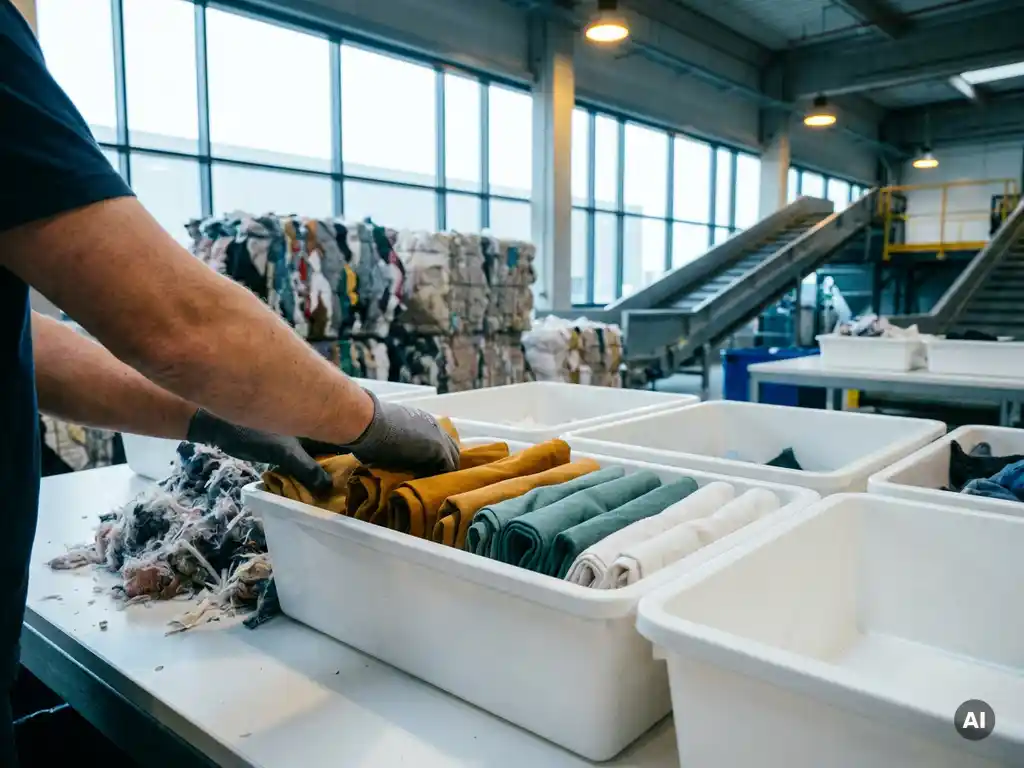
In the circular economy, used textiles are recycled in several ways: by mechanically shredding them into recycled fibers, through chemical processes to recover raw materials, and through direct reuse as secondhand goods. Which method is chosen depends primarily on the condition and composition of the textiles. The following sections explain the individual processes, the importance of sorting, and the role of digitization in the entire process.
What are some ways to return used textiles to the cycle?
Used textiles can be returned to the cycle in three basic ways: by reusing them as secondhand clothing, by mechanically recycling them into new fibers, or by chemically recycling them to recover chemical raw materials. Which method makes sense depends on the condition, material, and level of soiling of the textile.
Clothing in good condition should ideally go directly to the secondhand market—for example, through social department stores, online platforms, or by being exported to other countries. This is the most resource-efficient option because it does not require any additional processing.
Textiles that are no longer wearable are recycled either mechanically or chemically, depending on their material and quality. Both methods have different strengths and limitations. A third option is energy recovery—that is, incineration to generate heat or electricity. This is considered a last resort when none of the other options are feasible.
How does mechanical textile recycling work?
In mechanical textile recycling, used textiles are physically shredded, torn apart, and processed into recycled fibers. These fibers are then further processed into new yarns, nonwoven fabrics, or insulation materials. The process is well-established, cost-effective, and requires no chemicals; however, it reduces the fiber length and thus the quality of the material.
The process consists of several steps:
- Pre-sorting: Clothing is sorted by material, color, and condition.
- Shredding: Shredding machines break down the fabrics into increasingly shorter fibers.
- Processing: The fibers obtained are cleaned and prepared for further processing.
- Further processing: The fibers are used in new products, such as cleaning rags, upholstery material, insulation, or blended yarns.
The downside: The mechanical tearing process causes the fibers to shorten with each recycling cycle. Pure cotton fibers can still be processed easily, but blended fabrics made of cotton and polyester pose difficulties because the two materials are hard to separate. For high-quality new products, mechanically recycled fibers are therefore often only suitable to a limited extent and are frequently blended with virgin fibers.
What is chemical textile recycling, and when is it used?
Chemical textile recycling refers to processes in which textile fibers are broken down into their basic molecular building blocks using chemical processes. These raw materials can then be processed into new, high-quality fibers that are comparable in quality to virgin material. The process is particularly suitable for blended fabrics and heavily worn textiles.
Specifically, there are various chemical approaches:
- Solvent-based processes dissolve cellulose fibers such as cotton and use them to produce new Lyocell or viscose fibers.
- Glycolysis and Hydrolysis break down polyester fibers into their chemical components, which are then used to produce new polyester.
- Enzymatic Methods use biological enzymes to selectively break down certain types of fibers without damaging other materials.
Chemical recycling is primarily used when mechanical recycling reaches its limits, for example, with polyester-cotton blends or heavily soiled textiles. The technology is still in the scaling phase in many areas, but offers the potential for a truly sustainable textile production in a closed loop.
Why is sorting used textiles so important?
Sorting used textiles is the most important step in the entire recycling process because the quality and value of the recycled product depend directly on how accurately the materials are separated. Incorrectly sorted textiles reduce the quality of the recycled material, increase the effort required, and can render entire batches unusable.
Traditionally, sorting is done manually in sorting facilities. Experienced employees sort textiles by material type, color, condition, and potential use. This is time-consuming and prone to errors, especially with blended fabrics that cannot be clearly identified by their appearance.
Modern sorting technologies rely on automated near-infrared spectroscopy (NIR), which analyzes fiber compositions in fractions of a second. When combined with robot-assisted sorting systems, accuracy can be significantly improved. Nevertheless, in many countries, the sorting infrastructure remains a bottleneck that limits the total volume of recycling.
What role does digitization play in the textile recycling process?
Digitization makes the textile recycling process more transparent, efficient, and scalable. Digital systems track material flows, manage sorting processes, and provide the data foundation necessary for a functioning Operational Data Collection is needed in the cycle. Without reliable data, it is impossible to establish a closed-loop system.
Specifically, digitization provides support in several areas:
- Digital Product Passports Store information about material composition, origin, and processing steps directly on the product, for example, using QR codes or RFID tags. This makes subsequent sorting and recycling much easier.
- Production Control and MES Systems help manufacturers integrate recycled materials into their production processes in a targeted manner and monitor their quality.
- Data-Driven Sorting AI and sensor technology increase sorting accuracy and reduce the amount of manual work required.
- Transparency in the Supply Chain Digital platforms make it possible to track recycling rates and quantify sustainability goals.
Especially for companies that Digitally Control Production Processes, the integration of ERP systems and recycling data opens up new possibilities for incorporating circular material flows directly into corporate planning.
What happens to used textiles that cannot be recycled?
Used textiles that cannot be reused or recycled mechanically or chemically are generally used for energy recovery—that is, incinerated to generate heat or electricity. While this is not a circular economy solution, it at least prevents landfilling and harnesses the energy content of the materials.
Which textiles fall into this category depends on several factors:
- Heavily soiled or contaminated textiles that cannot be cleaned
- Complex composite materials made of many different substances that cannot be separated economically
- Textiles with coatings, laminates, or integrated electronic components
- Materials for which no economically viable recycling technology currently exists
In the circular economy, energy recovery is considered a last resort. It is at the bottom of the recovery hierarchy because the material value is irretrievably lost in the process. The goal of a true circular economy in the textile sector is to reduce this proportion as much as possible through better product design, improved sorting technology, and new recycling processes.
How update texware Supports the Digitization of Circular Textile Processes
Here at update texware, we have been actively working on the digitization of circular processes in the textile industry since 2025. With our software, we help companies integrate recycled materials into their production and planning processes and make material flows transparent. These are the specific areas where our solutions come into play:
- texware/ERP integrates recycled materials into materials management and production planning, enabling companies to make targeted use of secondary raw materials.
- texware/MES manages production processes and enables quality monitoring of recycled fibers directly on the production line.
- texware/Monitoring, It collects operational data and establishes the digital foundation for transparent, traceable circular processes.
- texware/DeepSee provides business intelligence reports that allow you to measure recycling rates and sustainability goals.
If you'd like to know how your textile production If you think your business could benefit from digital circular economy solutions, please feel free to contact us. We look forward to Contacting You.
Related Articles
- What consumer habits prevent a functioning circular economy for textiles?
- How can energy consumption in textile production be optimized by 2026?
- How do you implement energy management in the textile industry?
- Why is AI-driven manufacturing so important for the textile value chain?
- How do you get started with energy monitoring in textile production?