
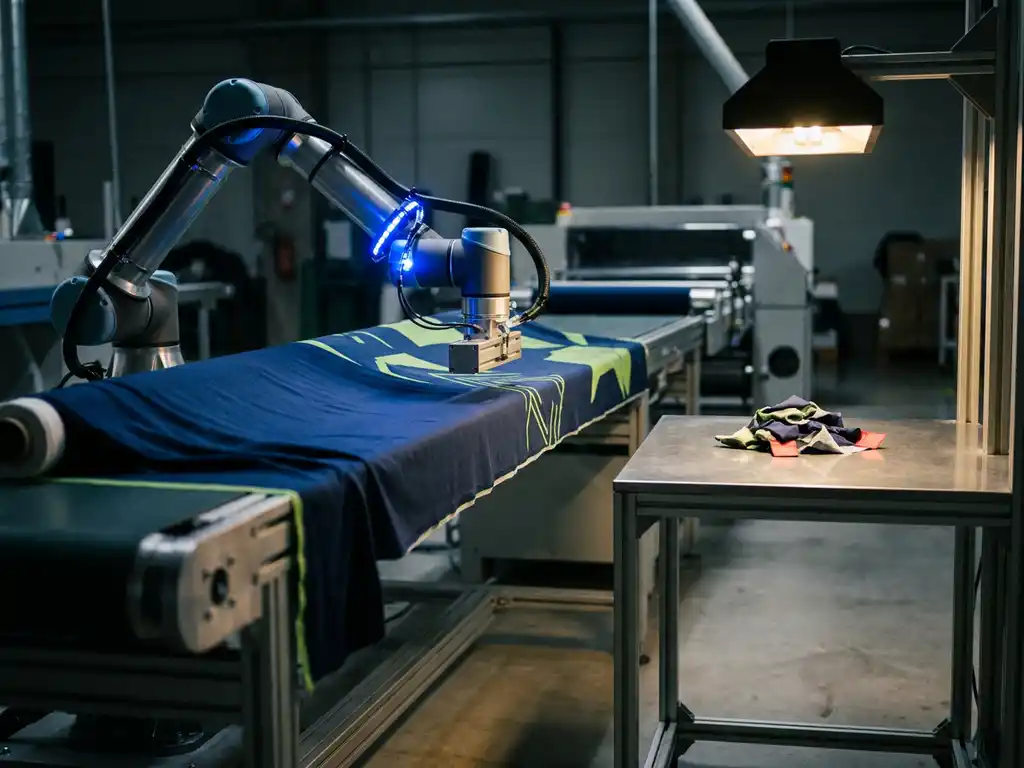
Yes, AI-powered manufacturing can significantly reduce the scrap rate in the textile industry. Modern AI systems detect quality defects—such as weaving errors, color variations, or yarn breaks—in real time and even while the production process is underway, long before defective goods are processed further. For small and medium-sized textile companies, getting started is now more accessible than ever before, because many solutions are modular and can be implemented in stages. The following questions highlight where AI specifically comes into play, which processes benefit from it, and when the investment truly pays off.
How does waste occur in textile production?
In textile production, defective products arise whenever materials, machines, or processes deviate from the standard without anyone intervening in time. The most common causes are yarn irregularities, weaving defects, color variations during dyeing, cutting errors in garment manufacturing, and machine wear and tear, which gradually affects product quality.
A particular problem is that many of these defects are not detected until late in the process—sometimes not until the final inspection at the end of the production line, or even at the customer’s site. By that point, the defective material has already passed through several stages of production, resulting in a significant loss of value. In practice, this means that a single yarn break in the weaving mill can render an entire section of fabric unusable if it is not detected immediately.
Added to this is the human factor. Visual quality control performed by employees is exhausting, subjective, and prone to errors, especially at high production speeds and during long shifts. The result is fluctuating quality standards and a scrap rate that is difficult to predict and even harder to systematically reduce.
How does AI detect quality defects in real time?
AI detects quality defects in textile manufacturing by analyzing camera and sensor data in real time and comparing it to learned patterns. If a product deviates from the defined quality parameters, the system immediately sounds an alarm or automatically triggers a stop before defective goods continue down the line.
The technology behind it is usually a combination of computer vision and machine learning. High-resolution cameras scan the surface of the merchandise at a speed and with a precision that the human eye cannot match. The AI model was trained on thousands of sample images and recognizes both flawless merchandise and typical defect patterns such as pilling, runs, color stains, or fabric damage.
In addition to visual inspection, sensors can monitor machine data such as thread tension, temperature, or rotational speed. If a value deviates from the norm, the AI recognizes the correlation between machine condition and product quality and can issue a proactive warning before the defect even becomes visible. This is called predictive quality control and is one of the biggest advantages over traditional visual inspection.
Which textile processes benefit most from AI?
Processes that benefit the most are those with high production speeds, recurring defect patterns, and visual inspections that were previously performed manually. These primarily include weaving, knitting, dyeing, and finishing, as well as cutting in garment manufacturing.
- Weaving and Knitting: Weave defects, runs, or broken threads can be reliably and immediately detected using computer vision, even before the defective section has been rewound.
- Dyeing and Finishing: Color variations are difficult to assess with the naked eye, especially under changing lighting conditions. Spectral sensors and AI provide objective, reproducible measurements in this context.
- Assembly and Cutting: AI can optimize sewing patterns to minimize fabric waste while also checking whether the pieces are cut and positioned correctly.
- Inspection of Goods: Digital product inspection systems replace or supplement manual end-of-line inspections and automatically document defects for later analysis.
Processes involving very small batch sizes or highly customized production benefit less, because AI models require a certain amount of data to learn. In those cases, human oversight remains more important for the time being.
How much does AI-powered quality control cost for small textile companies?
The cost of AI-based quality control varies widely depending on scope, technology, and the level of integration. Simple camera-based inspection systems for a single production step can already be implemented today for a mid-five-figure amount. Fully integrated solutions for multiple production lines are correspondingly more expensive.
For small businesses, it makes sense to start with a clearly defined pilot project—for example, automated product inspection at a single stage of production. This allows the benefits to be measured concretely before investing further. Many providers now also offer cloud-based models that do not require expensive in-house IT infrastructure and keep monthly costs predictable.
It’s important to look at the big picture: If AI reduces the scrap rate by several percentage points, that directly saves on materials, energy, and labor hours. In material-intensive textile processes, such an investment can pay for itself within one to two years. If you don’t know the figures, you should first determine your own scrap rate and the associated annual costs—that is the basis of any serious profitability analysis.
How does AI-powered quality assurance integrate into a textile ERP system?
AI-based quality assurance delivers its full benefits when it is directly integrated with the ERP system. In this case, quality data is automatically incorporated into order processing, materials management, and production planning, rather than remaining isolated in a standalone system.
Specifically, this means that when an inspection system reports an error, the ERP system can respond immediately. It can trigger a production halt, block the affected inventory items, schedule rework, or notify the purchasing department of material issues. Without this integration, AI remains a tool that detects errors but does not take action.
For textile companies, this means a industry-specific ERP It’s important that the system truly understands textile processes. A generic ERP system doesn’t recognize fabric defect classes, yarn lots, or color formulas. The interfaces between the quality management system and the ERP must be tailored to textile processes; otherwise, new data silos will emerge instead of true integration. Complementary tools such as a Manufacturing Execution System (MES) or production data collection can help integrate machine and quality data directly into the digital production flow.
When Is AI-Powered Manufacturing Really Worth It for a Textile Company?
AI-driven manufacturing is worthwhile for a textile company if the current scrap rate is measurable and the associated costs can be quantified, if production volumes and repeat rates are high enough to allow AI models to learn, and if the company is willing to adapt its processes and data structures.
As a rule of thumb: The higher the material value and the faster the production line, the sooner AI pays for itself. Companies that process expensive specialty yarns or technical textiles will see benefits sooner than those with low-cost mass-production processes. Companies that regularly receive complaints or experience quality issues in their supply chain should also consider implementing AI-based quality control early on.
Its use is less practical when production volumes are very small, products vary widely, or when basic process and data discipline is still lacking. AI requires clean input data and stable processes as prerequisites. Anyone still working with spreadsheets and lacking systematic quality documentation should start there first and establish a solid digital foundation before implementing AI systems.
How update texware Helps with AI-Powered Quality Assurance
Here at update texware, we’ve been developing software exclusively for the textile industry for more than 40 years. That means when it comes to integrating AI-powered quality assurance into your ERP system, you don’t have to explain to us what a fabric defect is or how yarn lots are managed. We know your processes.
Specifically, we support you by:
- texware/ERP: The modular core system integrates order processing, materials management, and production planning, and provides the data foundation that AI systems need.
- texware/MES: Production control collects machine data in real time and bridges the gap between the shop floor and the ERP system.
- texware/Monitoring: Production data collection digitizes production processes and enables systematic analysis of quality data.
- texware/Inspection: Digital product inspection directly within the system, integrated into the production workflow, without any media breaks.
- texware/DeepSee: Business Intelligence that makes quality data visible and helps you identify patterns in your scrap rate.
You can start with a modular approach and expand step by step, in a way that fits your business and your budget. If you'd like to know what that might look like specifically for your company, Just get in touch with us. We'll work together to figure out the best place for you to start.
Related Articles
- How do you get started with sustainable textile production in your business?
- How does AI reduce errors in textile order processing?
- How can AI-powered manufacturing be integrated into existing ERP systems?
- What is energy monitoring in the textile industry?
- What data is needed for predictive maintenance on textile machines?