
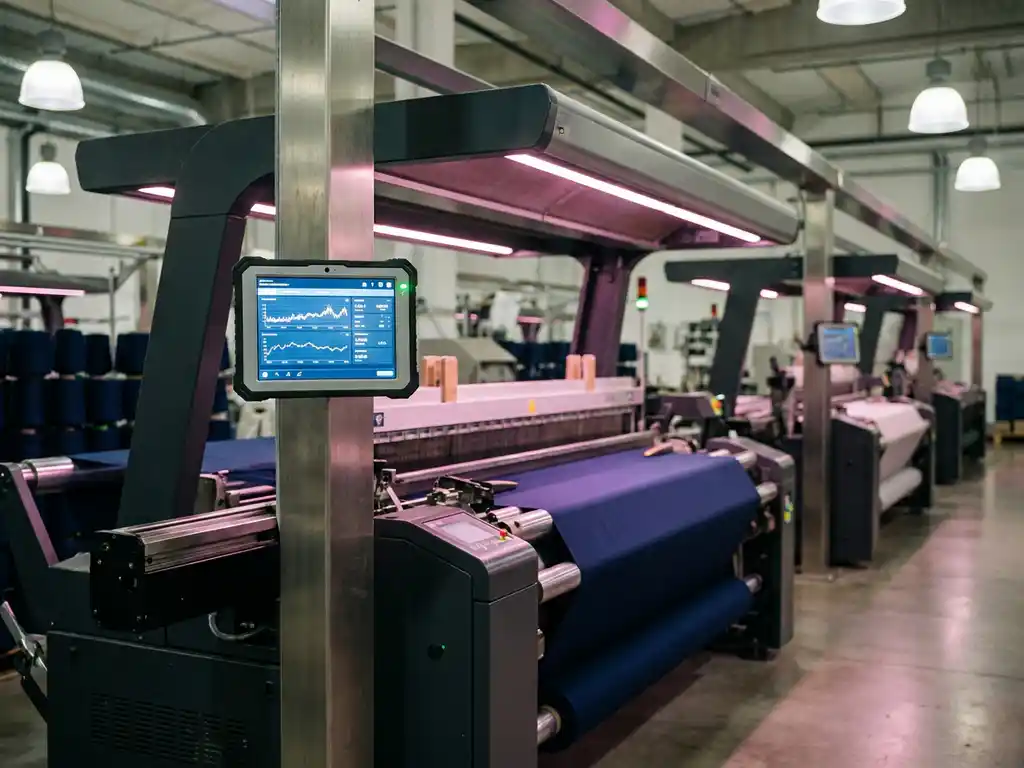
Energy monitoring reduces production costs in textile companies by providing real-time visibility into the energy consumption of individual machines and process steps. By identifying where energy is being wasted, companies can take targeted action, reduce peak loads, and optimize consumption over the long term. The following sections answer the most important questions about energy monitoring in the textile industry.
Which production processes consume the most energy in a textile company?
The most energy-intensive processes in textile production are finishing, treatment, and thermal processes such as drying, setting, and dyeing. These processes require large amounts of heat and steam, often around the clock. In addition, weaving machines, knitting machines, and spinning units are also significant energy consumers, especially when they operate continuously.
More specifically, the main consumers can be divided into three categories:
- Thermal Processes: Dyeing facilities, drying systems, fixing frames, and steam generators are at the top of the consumption list in most plants. These often account for more than half of the total energy budget.
- Mechanical Drives: Looms, circular knitting machines, spinning machines, and needle machines continuously consume large amounts of electricity, especially if they are not controlled according to demand.
- Compressed Air and Air Conditioning: Many textile companies underestimate the energy requirements of their compressed air systems and air conditioning units, which are necessary to maintain stable production conditions.
This is exactly where Energy Monitoring in Textile Production To: Only when consumption per machine and per process step can be measured is it possible to identify specific opportunities for savings.
How does energy monitoring work technically in textile production?
Energy monitoring in textile production relies on sensors and measuring devices that are attached to machines, pipes, and equipment and collect consumption data in real time. This data is transmitted to central software, which analyzes and visualizes it and triggers alarms in the event of deviations.
The technical architecture typically consists of three layers:
- Level of detail: Electricity meters, heat meters, and pressure sensors measure consumption directly at the machine or at the grid connection point. Modern devices transmit the data via OPC-UA, Modbus, or similar protocols.
- Level of communication: An industrial network or gateway collects the measurement data and forwards it to the analysis software. It doesn't matter whether the solution runs locally, in a data center, or in the cloud.
- Analysis Level: The software displays consumption trends graphically, compares target values with actual values, and immediately highlights peak loads or unusual consumption patterns.
An important side effect of this transparency: Unusual consumption patterns often indicate incipient machine malfunctions, which directly points to Predictive Maintenance for Textile Machinery leads to. If a loom's power consumption suddenly increases without any change in production, this can be an early warning sign of bearing damage or belt wear.
What cost savings can realistically be achieved through energy monitoring?
Through consistent energy monitoring in textile companies, savings of 10 to 20 percent on energy costs are realistically achievable without limiting production. The exact figure depends on how well-optimized operations already are and how consistently the collected data is utilized.
Specific strategies that consistently prove effective in practice:
- Peak Load Management: Many energy providers calculate a power rate based on the highest monthly peak load. Those who reduce these peaks by staggering the startup of their machines can significantly lower their fixed costs.
- Idle Detection: Devices that consume unnecessary energy in standby mode can be turned off selectively or put into a true sleep mode.
- Process Optimization: When dyeing programs or drying times are adjusted based on actual consumption data, energy consumption per unit produced decreases.
- Predictive Maintenance: Machines that consume more energy than necessary due to a creeping defect are detected earlier and repaired before a costly breakdown occurs.
What is the difference between energy monitoring and a full-fledged MES?
Energy monitoring focuses exclusively on the collection and analysis of energy consumption data. A Manufacturing Execution System (MES) is significantly more comprehensive: It controls and documents the entire production process, from order release and machine scheduling to quality control and production data collection.
Simply put: Energy monitoring is a feature that can either complement an MES or be operated as a standalone solution. Here’s an overview of the differences:
- Energy monitoring answers the question: Where and when do we use how much energy?
- MES answers the questions: What are we currently producing, with what resources, to what standard of quality, and how efficiently?
For many small and medium-sized textile companies, energy monitoring is a sensible first step toward digitalization because the effort involved is manageable and the benefits become apparent quickly. A comprehensive MES for the Textile Industry offers the next step in expansion as the business continues to grow or as more complex control tasks arise.
When is energy monitoring worthwhile for small and medium-sized textile companies?
Energy monitoring is worthwhile for small and medium-sized textile companies once energy costs begin to have a noticeable impact on profits or when there is a lack of transparency regarding the machinery. In the textile industry, this is often the case even for companies with five to ten production machines.
Here are some specific situations in which getting started is particularly beneficial:
- Energy costs are rising even though production has not increased.
- Machines continue to run outside of core shifts without anyone noticing.
- Unplanned machine breakdowns are becoming more frequent, and the cause is unclear.
- The company would like to document its sustainability goals or report its carbon footprint.
- An energy audit is coming up, and we don't have reliable consumption data.
Especially for companies that still rely on spreadsheets or manual record-keeping, the switch to a digital energy monitoring system is a direct path to measurable savings without significant implementation effort.
How can energy monitoring be integrated into existing textile ERP systems?
Energy monitoring can be integrated into existing textile ERP systems via standardized interfaces, allowing energy consumption data to be displayed directly in the ERP system and linked to production and cost data. This requires an open interface architecture on both sides.
In practice, integration usually takes place in the following ways:
- API integration: Modern energy monitoring platforms offer REST APIs through which consumption data is transferred to the ERP system. The ERP system can then allocate energy costs directly to orders or cost centers.
- Production Data Acquisition (PDA): Many ERP systems for the textile industry already include a production data acquisition (PDC) component. Energy data can be fed into this system as an additional metric.
- Business Intelligence Layer: By consolidating energy data and ERP data in a BI system, you can generate reports that show how much energy a specific order, machine type, or production step actually cost.
A well-integrated solution makes Energy Monitoring in the Textile Industry make it an integral part of daily reporting, rather than using it as a standalone tool. This increases acceptance within the team and ensures that the data is actually put to use.
How update texware Helps with Energy Monitoring and the Digital Transformation of Your Production
Here at update texware, we have firsthand experience with textile production, and that’s exactly what sets us apart. Our solutions aren’t designed for industry in general, but specifically for the textile value chain—from yarn production through weaving and knitting to garment manufacturing.
With our portfolio, we provide you with concrete support in the following areas:
- texware/Monitoring, It collects operational data and energy consumption directly from the machine and makes it available in real time.
- texware/MES links energy data with production control, allowing you to optimize both consumption and capacity utilization simultaneously.
- texware/DeepSee imports all data into a business intelligence system that allows you to analyze energy costs by order, machine, or production step.
- texware/ERP As the core of the system, it connects all modules and provides you with a comprehensive view of production, costs, and energy consumption in a single system.
Whether you're just starting to digitize your production or want to expand an existing system, we'll guide you every step of the way. Please contact us, and we'll show you which solution is right for your current situation.
Related Articles
- How does AI-powered production control work in the textile industry?
- How can AI-powered manufacturing be integrated into existing ERP systems?
- How do you get started with energy monitoring in textile production?
- What data is needed for predictive maintenance on textile machines?
- Can energy monitoring extend the service life of machinery in a textile plant?