
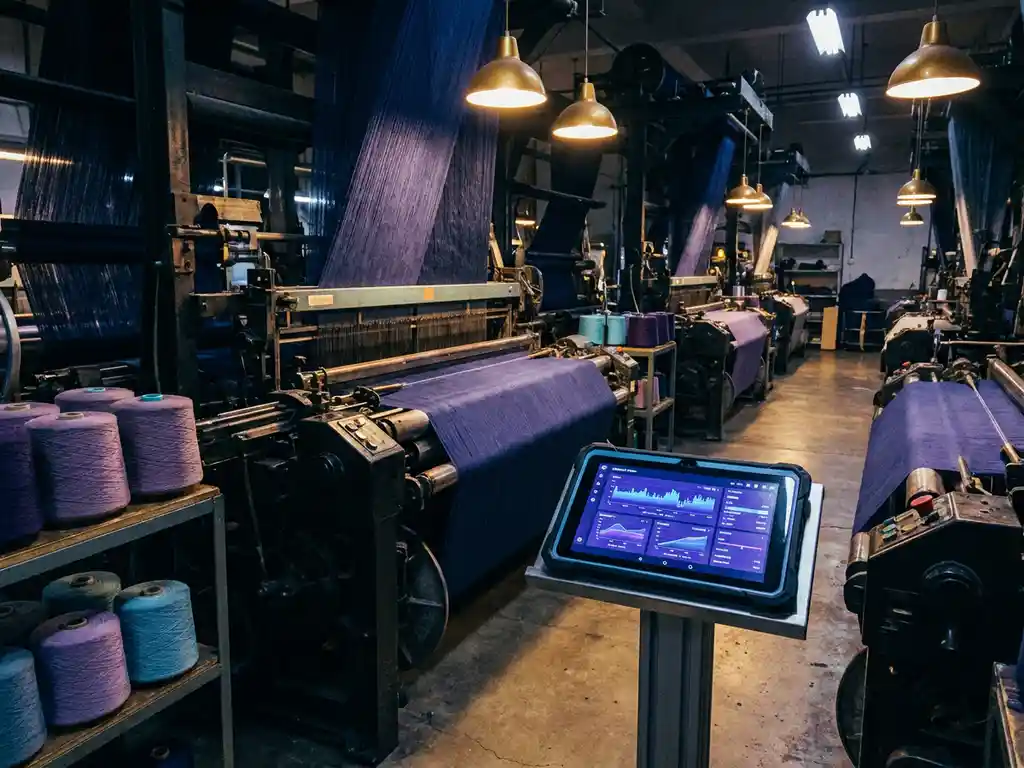
AI-powered production control is worthwhile in a textile manufacturing facility as soon as sufficient digital process data is available and manual control causes measurable bottlenecks. In practice, this is often the case for medium-sized or larger facilities, but it can also become relevant earlier if production complexity is high. The following questions highlight what really matters.
At what size of operation does AI become cost-effective in production control?
AI in production control pays off not based on a specific number of employees, but rather on a specific volume of data and process complexity. Facilities with multiple machine groups, varying product types, and high planning demands benefit significantly sooner than simply structured single-product operations. As a rule of thumb, companies that manage more than 20 to 30 production orders per day generally have enough complexity for AI algorithms to make a real difference.
What matters is not so much the size of the company as how much time schedulers spend today manually adjusting schedules. If order sequences are rearranged multiple times a day, delivery dates are regularly pushed back, or machine utilization fluctuates wildly, these are clear signs that an intelligent system can do more than a person using a spreadsheet. Smaller businesses with stable, repetitive processes, on the other hand, often benefit more from a solid ERP and MES systems rather than by AI layers on top of it.
Which processes in textile production benefit the most from AI?
Processes with many variables, tight time windows, and frequent disruptions benefit the most. These include machine scheduling, sequence optimization for color changes or yarn batches, the prediction of maintenance needs, and quality control based on sensor data. These areas generate enough data points for AI models to identify meaningful patterns.
- Sequence Planning: AI calculates optimal machine sequences—taking setup times, color sequences, and delivery priorities into account—faster and more accurately than manual planning.
- Predictive Maintenance: Sensor data from weaving machines, knitting machines, or finishing equipment makes it possible to predict maintenance needs before breakdowns occur.
- Quality Control: Image processing systems using AI detect web defects, color variations, or surface defects more reliably and quickly than manual inspection.
- Demand Planning: AI analyzes order patterns, seasonal trends, and inventory levels to identify material requirements early on and prevent shortages.
On the other hand, AI is less well-suited for highly skilled or creative processes in which human judgment and experience cannot be replaced by data patterns.
What distinguishes AI-powered control from traditional MES?
A traditional MES records what is happening and executes defined rules. AI-powered control goes a step further: It learns from historical data, recognizes patterns, and independently makes recommendations or decisions that go beyond fixed sets of rules. The key difference lies in adaptability.
An MES says: „If Machine A is occupied, assign Job B to Machine C.“ An AI system says: „Based on the last 500 orders, it makes more sense in this scenario to postpone Order B and keep Machine A free, because a rush order with higher priority will arrive in two hours.“ The traditional MES reacts based on rules, while AI anticipates and optimizes dynamically.
In practice, these two approaches are not in competition with each other. Today, AI functions are often implemented as an extension layer on top of an existing MES. Those who do not yet have an MES should take that step first before introducing AI optimization, because without structured process data, AI has no basis for learning.
What are the typical implementation costs for AI in textile production?
The implementation costs for AI in textile production vary widely and depend on whether AI is integrated as a module into an existing ERP or MES system or implemented as a standalone solution. Integrated AI modules generally cost significantly less than separate platforms because the data connection is already in place.
Broadly speaking, there are three main cost categories:
- Software licenses or SaaS fees: Depending on the provider and the range of features, these range from a few thousand to several tens of thousands of euros per year.
- Implementation and Data Preparation: This aspect is often underestimated. Data must be cleaned, structured, and integrated. Depending on the initial situation, this can cost just as much as the software itself.
- Training and Change Management: Employees need to understand how to use AI recommendations. Without this step, even good software won't be used.
Those starting with a modest budget should prioritize specific use cases—such as order optimization—and expand only after the benefits have been proven. A “big bang” approach is rarely worthwhile.
What data is needed for AI-powered production control in a textile manufacturing facility?
AI-powered production control requires structured, complete, and historical data from ongoing operations. Specifically, this means that machine statuses, setup times, order turnaround times, scrap rates, and fault logs should be recorded digitally and as completely as possible. Without this foundation, no AI model can be trained effectively.
In the textile industry, data sources are often still heterogeneous. Machines from different manufacturers and of different vintages provide data in various formats—and some provide no data at all. In this context, production data acquisition (PDA) is the logical first step before AI functions can be effectively implemented. What matters here is not only the quantity of data, but also its quality: Erroneous or inconsistent inputs lead to incorrect AI recommendations.
In practice, the following are considered the minimum requirements for initial AI applications:
- At least 12 months of historical production data
- Digital Tracking of Job Times and Machine Status
- Consistent product master data with clear attributes
- Connecting the machines to a central system
How long should a textile company wait before implementing AI?
A textile company should wait to implement AI if its core digital processes are not yet running smoothly. AI cannot fix flawed processes; it simply amplifies what already exists. Companies that still rely on paper lists, siloed systems, or a non-integrated software environment should first lay this foundation.
Specific warning signs that indicate a lack of maturity:
- Order and production data are still entered manually into spreadsheets
- There is no end-to-end ERP system that integrates order entry, materials management, and production
- Machine data is not recorded digitally, or is recorded only sporadically
- Master data is incomplete or inconsistent
Anyone who invests directly in AI in this situation risks spending a lot of money for little benefit. The right approach is to first digitize and stabilize processes, then build AI on top of them as the next step. This isn’t a step backward—it’s the only approach that works in the long run. Learn more about the Requirements of the Textile Industry You can find suitable digitization approaches in our overview.
How update texware Helps with AI-Powered Production Control
At update texware, we know that for textile companies, the path to AI-powered production often begins with laying the right foundation. That’s why we offer an integrated software platform that starts exactly where AI will later be most effective.
- texware/ERP It integrates order intake, materials management, and production planning into a single system, thereby creating the data foundation that AI applications need.
- texware/MES manages production in real time and collects machine data in a structured manner, so that historical analyses and AI models can be based on clean data.
- texware/Monitoring, It digitizes production data collection and bridges the gap between machines and systems, even for older equipment.
- texware/Planboard provides graphical production control center functions that serve as a bridge between rule-based control and AI-driven optimization.
- texware/DeepSee makes production and operational data usable for business intelligence, an important step toward data-driven decision-making.
Our team consists of specialists who come from the textile industry or have worked in it for many years. We speak your language and understand your processes. If you’d like to know where your business stands on the path to AI-powered production, Please feel free to contact us and we'll work together to figure out what the next logical step is for you.
Related Articles
- What is meant by a circular economy in the textile industry?
- How does ERP software support circular processes in the textile industry?
- What consumer habits prevent a functioning circular economy for textiles?
- What is energy monitoring in the textile industry?
- When Is Energy Monitoring Worth It for Small Textile Companies?