
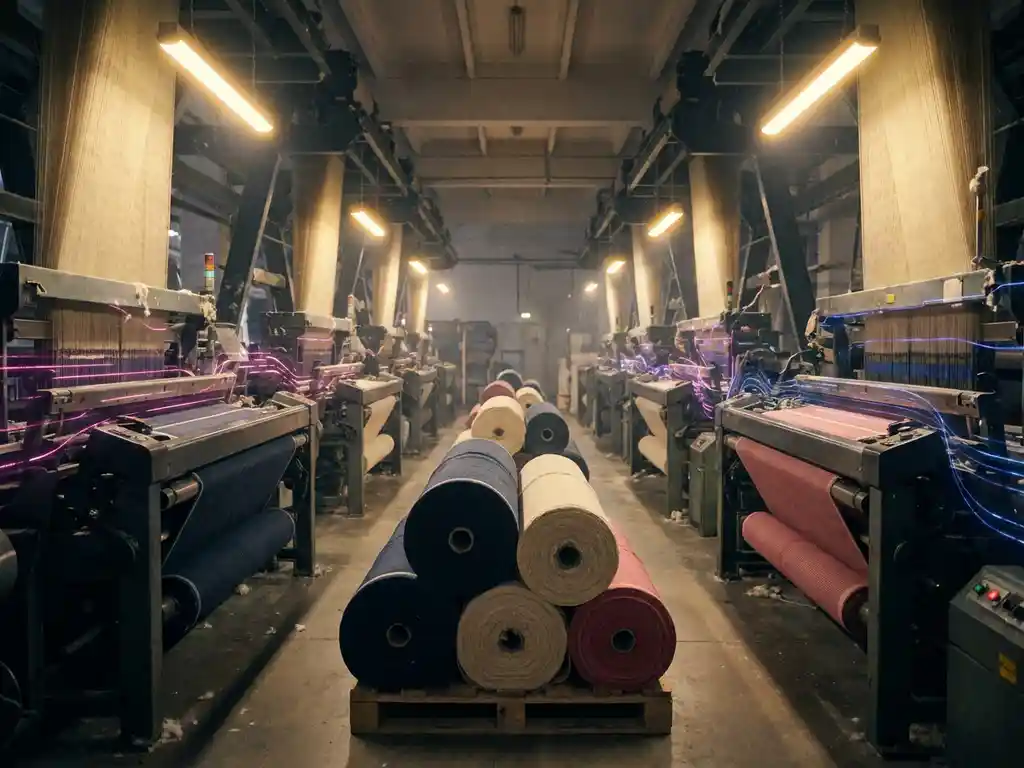
Energy monitoring in the textile industry refers to the systematic collection, analysis, and visualization of energy consumption in a textile facility in order to recognize consumption patterns, identify waste, and reduce electricity consumption in a targeted manner. In other words, the goal is to know exactly who is consuming how much energy in production, when, and why. The following sections answer the most important questions regarding energy monitoring, potential savings, and practical implementation in textile facilities.
What types of energy-consuming equipment are found in a textile factory?
In a textile plant, production machinery, air conditioning and humidification systems, compressed air systems, and lighting are among the largest energy consumers. Depending on the production stage, other energy-intensive processes may also be involved, such as dyeing equipment, drying units, or finishing machines.
Specifically, typical energy consumers can be categorized into the following areas:
- Weaving machines, knitting machines, and spinning machines: They often run around the clock and have a consistently high base load.
- Compressed Air Generation: In many textile plants, compressors are among the largest single energy consumers, often with significant potential for energy loss due to leaks.
- Air Conditioning and Humidification: Precise indoor climate conditions are particularly necessary in spinning and weaving operations, which results in consistently high energy consumption.
- Thermal Processes: In addition to electricity, the dyeing, setting, drying, and finishing processes also consume large amounts of thermal energy.
- Lighting and Infrastructure: Often underestimated in large production facilities, but significant when taken as a whole.
Knowing which machines and systems consume how much energy is the basic prerequisite for any effective energy monitoring in production. Without this data, energy savings remain a matter of chance.
How does energy monitoring work from a technical standpoint?
Energy monitoring works through a combination of measurement technology, data transmission, and analysis software. Measuring devices are installed at relevant consumption points—such as machines, systems, or sections of a building—to continuously record electricity, heat, or compressed air usage and transmit the data to a central platform.
The technical process is divided into three layers:
- Data Collection: Smart meters, current transformers, or sensor systems measure consumption directly at the machine or at the transfer point. Modern systems use protocols such as Modbus, M-Bus, or OPC UA to connect different types of machines.
- Transmission: The measurement data is transmitted to a central database in real time or at short intervals, either via the internal network or via cloud connections.
- Analysis and Visualization: Monitoring software processes the raw data, presenting it as dashboards, load profiles, comparative analyses, or automatic alerts when thresholds are exceeded.
The granularity of the measurement is crucial in practice. If you monitor only the main meter, you’ll see only the total consumption. If you track individual machines or production lines separately, you can take targeted action. For the textile production This means that the more detailed the measurement points, the more precisely optimization measures can be derived.
What are the typical cost-saving opportunities offered by energy monitoring in the textile industry?
Energy monitoring typically enables textile manufacturers to achieve savings of 10 to 20 percent of their total energy consumption without having to invest in new machinery. The greatest opportunities lie in reducing idle consumption, optimizing peak loads, and identifying hidden losses.
Specific cost-saving opportunities that regularly arise in practice:
- Idle and Standby: Machines that continue to run after their shift ends or remain in energy-wasting standby mode create an unnecessary base load. Monitoring makes these time periods visible.
- Compressed air leaks: In many facilities, 20 to 30 percent of the compressed air produced is lost due to leaks without anyone noticing. Load profile analyses conducted at night, when production is halted, immediately reveal such losses.
- Peak Load Management: High peak load costs occur when many consumers start up at the same time. Monitoring helps stagger startup times and specifically smooth out peak loads.
- Process Optimization in Finishing: Temperatures, operating times, and capacity utilization rates of thermal power plants can be controlled more precisely based on actual consumption data.
The fastest way to reduce electricity consumption in the textile industry is in areas where data was previously lacking. Energy monitoring lays the groundwork for turning assumptions into concrete actions.
What legal requirements apply to energy management in textile companies?
In Germany, companies above a certain size are subject to mandatory energy management requirements. The most relevant regulations are the Energy Services Act (EDL-G), the Energy Efficiency Act (EnEfG), and ISO 50001, the international standard for energy management systems.
Specifically:
- Energy Audits in Accordance with EDL-G: Non-SMEs are required to conduct an energy audit every four years or, alternatively, to implement a certified energy management system in accordance with ISO 50001.
- Energy Efficiency Act (EnEfG): Since 2023, the EnEfG has required companies with a total annual energy consumption of more than 7.5 gigawatt-hours to implement an energy or environmental management system. By 2026, affected companies must also submit implementation plans for cost-effective energy efficiency measures.
- SME Exemptions: Small and medium-sized enterprises are exempt from certain obligations but can benefit from support programs such as the BAFA energy audit if they voluntarily implement measures.
For textile companies that export or operate within the supply chains of international brands, there are additional requirements under the Supply Chain Due Diligence Act and sustainability reports in accordance with the CSRD, which require transparent documentation of energy consumption.
When is energy monitoring worthwhile for small and medium-sized textile companies?
Energy monitoring is worthwhile for small and medium-sized textile companies once energy costs account for a significant portion of operating expenses and opportunities for optimization cannot be identified without reliable data. In most textile manufacturing facilities, this is already the case for operations with ten to twenty machines.
The following indicators suggest that it makes sense to get started:
- Energy costs are rising, even though production volumes and machinery have not changed significantly.
- There is no transparency regarding which machines or shifts consume a particularly large amount of electricity.
- Peak-load charges in electricity rates are high, but the causes are unclear.
- The company is about to undergo an energy audit or would like to apply for grants for energy efficiency measures.
- Customers and suppliers are asking for proof of sustainability and energy consumption data.
Modern monitoring solutions have a modular design and can be implemented in phases, allowing even a small business with a modest budget to get started. The investment typically pays for itself within one to three years through the savings achieved.
How can energy monitoring be integrated into an existing ERP system?
Energy monitoring can be integrated into an existing ERP system by transferring consumption data from the monitoring platform to the ERP database via interfaces. This allows energy costs to be directly allocated to the corresponding orders, machines, or cost centers, enabling precise cost estimation and post-calculation.
This integration offers several practical benefits:
- Energy costs per order: If the ERP system knows how much energy a machine consumes per hour, production orders can be calculated realistically instead of using flat rates.
- Automatic Reports: Energy consumption reports are no longer generated manually, but directly from the linked data in the ERP system and the monitoring platform.
- Production Planning and Energy Management: The production control center can schedule orders so that energy-intensive processes take place outside of peak load times.
- Sustainability Documentation: All relevant consumption data is available centrally and in a format suitable for analysis for CSRD reports or customer inquiries.
Technically, integration is achieved through standardized interfaces such as REST APIs or direct database connections. It is important that the monitoring solution offers open interfaces and that the ERP system is capable of processing this data. In the case of industry-specific software solutions In the textile industry, this connection is often already designed in advance and does not require complex custom fabrication.
How update texware Helps with Energy Monitoring in the Textile Industry
Here at update texware, we have hands-on experience with production processes in textile factories, and that’s exactly what makes the difference when it comes to integrating energy monitoring into an ERP environment. With texware/Monitoring, We offer a production data collection and digitization platform that was developed specifically to meet the needs of textile manufacturing companies and integrates seamlessly with texware/ERP.
Here's what that means for you:
- Direct linking of energy consumption data to production orders and cost centers in the ERP system
- Real-time visualization of consumption patterns and load profiles, without a separate standalone solution
- Automatic energy cost allocation for accurate pre- and post-job costing
- A modular approach that grows with your business, from the first measurement point to fully digitized production
- Support with documentation for energy audits, sustainability reports, and customer inquiries
You don't need to explain to us how a weaving mill or a finishing plant works. We already have that knowledge. If you'd like to know what energy monitoring could look like specifically in your facility, Please feel free to contact us and we'll look at it together.