
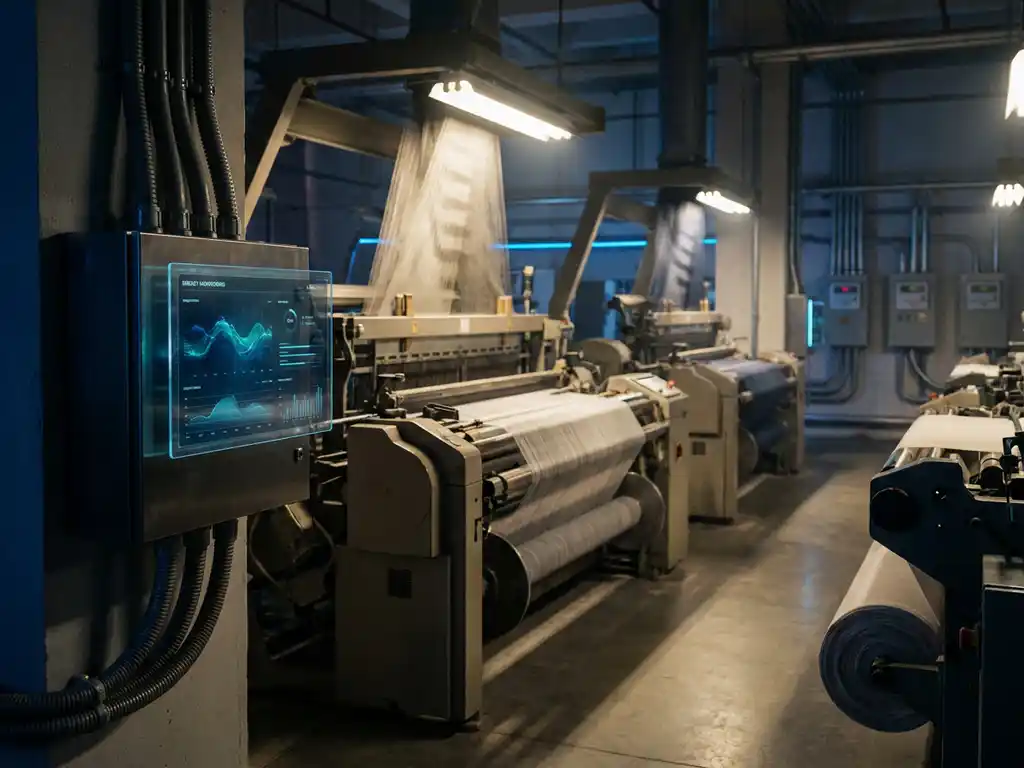
Energy management in production is implemented by first identifying the largest energy consumers in the facility, setting measurable goals, and then systematically integrating processes, technology, and software. This is particularly relevant for textile companies because energy is one of the largest cost items in production. This article answers the most important questions about getting started with a structured energy management system.
Which energy-consuming devices account for the largest share of energy use in textile factories?
In textile mills, the majority of energy consumption is accounted for by production machinery, air conditioning, and compressed air systems. Weaving machines, knitting machines, dyeing systems, and drying units often run around the clock and consume significant amounts of electricity and heat. In addition, lighting, compressed air, and steam generation are frequently underestimated costs.
Anyone who wants to reduce energy consumption should start by conducting a simple consumption analysis. The goal is to identify the machines and systems that account for the largest share of total consumption. In practice, these are often:
- Thermal processes such as drying, setting, and dyeing
- Compressed-air systems with poorly maintained lines
- Older drives without frequency converters
- Air Conditioning in Production Facilities with Strict Humidity Requirements
Even this initial overview reveals where there is potential for savings before a formal system is even implemented.
What is an energy management system in manufacturing?
An energy management system (EnMS) in manufacturing is a structured framework that enables a company to systematically track, evaluate, and specifically reduce its energy consumption. It encompasses measurement technology, processes, responsibilities, and software that, together, ensure that energy is not simply consumed but actively managed.
The term is closely linked to the ISO 50001 standard, which is recognized internationally as the standard for energy management systems. An EnMS based on this standard follows the so-called PDCA cycle: Plan, Do, Check, Act. This means that measures are planned, implemented, their effectiveness is reviewed, and the strategy is continuously adjusted.
An EnMS is particularly useful for textile companies because production processes are often complex, and energy consumption can vary significantly depending on order volume, shift, and machine utilization. A good system makes these fluctuations visible and helps companies take targeted action to address them.
What legal requirements apply to textile companies?
Textile companies in Germany are subject to different legal obligations regarding energy, depending on the size of their operations. Large companies that are not certified under ISO 50001 must conduct an energy audit every four years in accordance with the Energy Services Act (EDL-G). Smaller businesses are generally exempt from this requirement.
Starting in 2026, European regulations such as the revised Energy Efficiency Directive (EED) will also take on greater significance. It requires companies that meet certain thresholds to systematically track and report their energy consumption.
Regardless of whether it is mandatory, a voluntary energy management system is also worthwhile for smaller textile companies because it provides access to subsidy programs and tax breaks. The peak-load adjustment for energy and electricity taxes, for example, is contingent upon demonstrating that a functioning EnMS is in place. This makes investing in such a system not only environmentally sound but also economically sensible.
What is the step-by-step process for implementing an energy management system?
The best way to implement an energy management system in production is to follow a series of clearly sequential steps: track consumption, set goals, implement measures, and monitor results. By approaching this process in a structured manner, you can avoid costly mistakes and achieve visible results more quickly.
Step 1: Track and Analyze Energy Consumption
The first step is a comprehensive assessment. Which machines and systems consume how much energy? At what times? Are there seasonal fluctuations? For this analysis, you’ll need meter data, machine logs, and—ideally—a monitoring solution that captures consumption data in real time.
Step 2: Define Goals and Responsibilities
Without clear goals, energy management remains mere theory. Determine what percentage of your energy consumption you want to reduce and over what time frame. Appoint a person or team to oversee the implementation. This step is often the one that gets skipped most frequently in practice—and is consequently missing.
Step 3: Prioritize and Implement Measures
Not all measures require the same level of effort or are equally effective. Start with so-called „quick wins“: seal leaky compressed air lines, switch to LED lighting, and turn off machines during standby periods. Next, implement measures that require a higher investment, such as new drive technology or heat recovery.
Step 4: Measure Results and Continuously Improve the System
An EnMS is not a project with an end date, but rather an ongoing process. Regularly check whether the set goals are being met, and adjust the strategy as needed. This step completes the PDCA cycle and ensures that the system remains dynamic.
What software and tools support energy management in the textile industry?
Energy management software for manufacturing helps automatically collect and analyze consumption data and translate it into specific recommendations for action. For textile companies, solutions that can be integrated into existing production systems are particularly useful.
Relevant types of software include:
- Production Data Acquisition (PDA): Systems that collect machine data in real time and link energy consumption directly to production orders
- ERP systems with an energy module: Integrated solutions that factor energy costs directly into the cost calculation
- Business Intelligence Tools: Dashboards that highlight consumption trends and flag anomalies early on
- Monitoring platforms: Specialized solutions for real-time monitoring of machinery and equipment
For textile companies that Software Solutions for Manufacturing When searching for a solution, it is important that the chosen solution understands the specific processes of the industry. A generic tool that does not know what a sizing box or a setting machine is often provides analyses that are of little help.
How do you measure the success of an energy management system in a textile company?
The success of an energy management system is measured using specific metrics that compare energy consumption to production output. The most important indicator is specific energy consumption—that is, how much energy is consumed per unit produced, per kilogram of yarn, or per square meter of fabric.
Useful key performance indicators for textile companies include:
- Specific energy consumption: kWh per unit of production (e.g., per kg of yarn or meter of fabric)
- Energy costs as a percentage of production costs: Shows how much energy price fluctuations affect earnings
- Peak loads: High peak loads drive up grid fees and can be reduced through better production planning
- CO2 equivalent per unit of production: Relevant for sustainability reports and supplier requirements
It is important to compare these metrics regularly: with your own figures from the previous year, with your set goals, and, if possible, with industry benchmarks. Only by measuring can you know whether the measures are actually effective.
How update texware Helps with Energy Management in the Textile Industry
At update texware, we understand the processes in the textile industry based on decades of experience. That’s why we’ve designed our solutions to integrate energy management directly into your day-to-day operations, without requiring you to implement a separate, standalone system.
Specifically, we support you by:
- texware/Monitoring: Our production data collection and digitization platform collects machine data in real time and provides visibility into energy consumption at the job level
- texware/MES: Production control helps prevent peak loads through better planning and reduce downtime
- texware/DeepSee: Our business intelligence tool provides dashboards and reports that clearly illustrate consumption trends and potential savings
- texware/ERP: The integrated ERP system incorporates energy costs directly into the cost estimate, so you always know what an order really costs
All solutions are tailored to the textile value chain are tailored to your needs and can be implemented in a modular fashion. You start with what you need right now and expand as your business grows. If you'd like to know what this might look like specifically for your business, Please feel free to contact us.
Related Articles
- How do you get started with sustainable textile production in your business?
- What is the difference between AI-driven manufacturing and traditional production planning?
- When Is AI-Based Production Control Worth It in a Textile Manufacturing Facility?
- Why is AI-driven manufacturing so important for the textile value chain?
- Can energy monitoring extend the service life of machinery in a textile plant?