
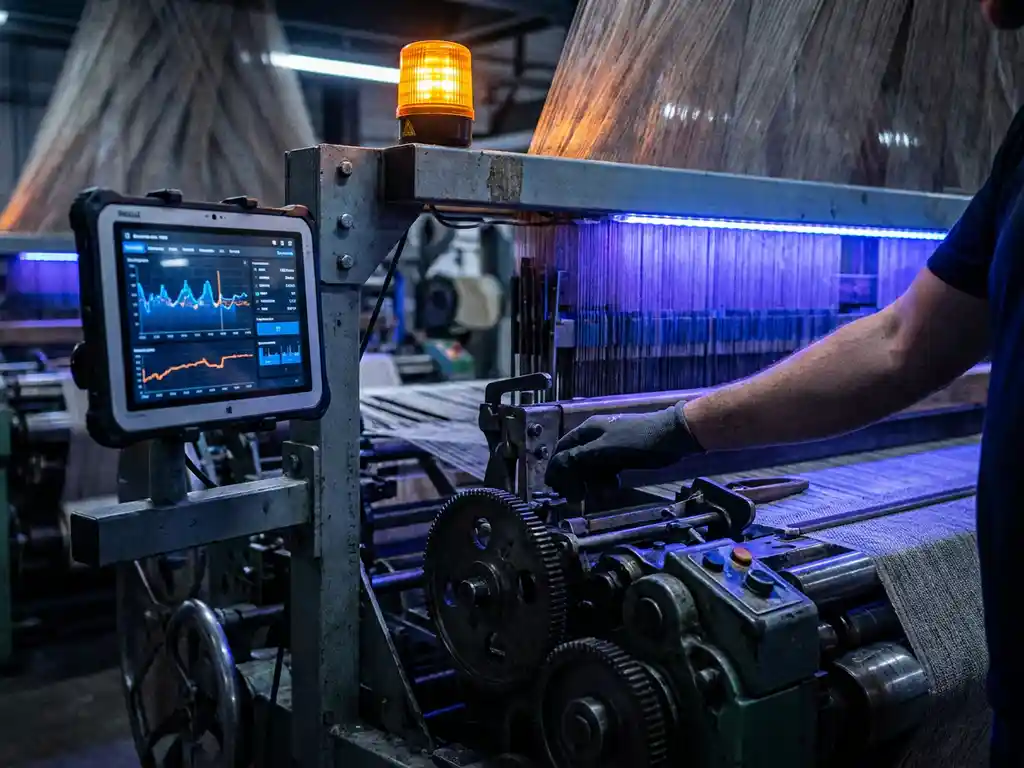
Predictive maintenance for textile machines works like this: Sensors continuously collect operational data such as temperature, vibration, and power consumption. Software analyzes this data in real time and identifies patterns that indicate an impending failure before it actually occurs. This gives you the opportunity to take targeted action before a machine comes to a standstill.
This concept, also known as predictive maintenance, is particularly relevant for textile manufacturers because unplanned machine downtime directly jeopardizes delivery deadlines and results in scrap. The following sections address the most important questions regarding data collection, system integration, and cost-effectiveness.
What data is collected during predictive maintenance?
In predictive maintenance for textile machinery, the primary data collected includes vibration data, temperatures, current consumption, rotational speeds, and pressure readings. This is supplemented by operating hours, error codes from the machine control system, and quality parameters such as yarn tensile strength and weft density. This data is continuously and automatically aggregated.
The sensors are mounted directly on critical components: bearings, drive motors, gearboxes, heating units, or tension rollers. In modern weaving machines, knitting machines, or finishing systems, many of these sensors are already installed at the factory. Older machines can be retrofitted with industrial sensors that transmit data via Wi-Fi or a wired connection.
This is particularly useful Energy Monitoring in a Textile Plant: If a motor's power consumption increases without any change in production parameters, this indicates increased frictional resistance—for example, due to a worn bearing. Such anomalies in energy consumption are often the first measurable signs of a problem, long before a failure occurs.
How does the system detect an impending machine failure?
The system detects an impending failure by comparing current measurements with historical normal values and identifying statistically significant deviations. If certain parameters exceed defined thresholds or if a pattern changes over time, the system triggers a maintenance alert.
Modern predictive maintenance systems use machine learning algorithms. The system learns how a machine behaves during normal operation and automatically detects deviations. The longer the system runs, the more accurate the predictions become.
Here’s a concrete example: A ring spinning machine shows a slight but steady increase in bearing temperature over several weeks. The value is still within the safe range, but the trend is noticeable. The system recognizes this pattern, calculates—based on historical data—when a critical condition is likely to be reached, and suggests a maintenance appointment. This allows you to replace the bearing before the machine breaks down.
What is the difference between predictive and preventive maintenance?
Preventive maintenance follows a fixed schedule, for example, every 500 operating hours. Predictive maintenance, on the other hand, responds to the machine's actual condition. It is triggered only when data indicates an impending failure, regardless of how long it has been since the machine was last serviced.
The practical difference is significant:
- Preventive Maintenance Replaces parts according to a schedule, even if they are still fully functional. This is safer than no maintenance at all, but it is often inefficient.
- Predictive Maintenance Replace parts only when wear and tear truly necessitates it. This reduces unnecessary maintenance costs and downtime.
- Corrective Maintenance The third option is to wait until something breaks before making repairs. This results in the highest costs due to unplanned downtime.
For textile companies that rely heavily on machinery and have tight deadlines, predictive maintenance makes the most economic sense because it prevents downtime without tying up resources for unnecessary maintenance intervals.
Which textile machines are suitable for predictive maintenance?
In general, all textile machines with electric drives, mechanical components, and controllable processes are suitable for predictive maintenance. In practice, machines with high utilization rates, long setup times, or a high risk of scrap in the event of a breakdown benefit the most.
Some examples of suitable options include:
- Weaving machines (rapier, air-jet, and rapier-type looms)
- Knitting Machines (Flat and Circular Knitting Machines)
- Ring-spinning and rotor-spinning machines
- Finishing equipment (dyeing machines, stretching frames, calender rolls)
- Sewing Machines in Garment Manufacturing with Automated Drives
- Coating and Laminating Systems
Simple, manually operated machines without sensors or a control system connection are more difficult to integrate, but can be equipped with retrofittable sensors. The Software Portfolio for Textile Companies Today, it offers solutions that gradually integrate even older machinery into a digital monitoring system.
How is predictive maintenance integrated into existing production systems?
The integration of predictive maintenance into existing production systems typically takes place in three steps: Sensors collect machine data; middleware transmits and processes this data; and a higher-level system, such as an MES or ERP, makes the information available for maintenance planning and production control.
Step 1: Data Collection and Integration
Modern machines communicate via standardized protocols such as OPC-UA or MQTT. Older systems are equipped with external sensors that measure vibration, temperature, and current. This data is fed into a central platform, often referred to as an IoT gateway.
Step 2: Analysis and Alerting
The analysis software evaluates the incoming data and compares it with reference values. If there are any deviations, the system automatically generates maintenance orders or alerts, which are forwarded directly to the appropriate staff members. The Energy Monitoring in the Textile Industry is an important component here because electrical data provides particularly early indications of wear and tear.
Integration with an existing ERP system is important so that maintenance orders are automatically incorporated into production planning and downtime can be scheduled in a targeted manner, rather than interrupting ongoing operations.
When will the costs of a predictive maintenance system pay for themselves?
The payback period depends on the number of machines, the historical frequency of downtime, and the cost per downtime event. In the textile industry, many companies report that the investment pays for itself within one to three years, especially if unplanned downtime has occurred regularly in the past.
The relevant cost factors on the expenditure side are sensors, software licenses, integration, and training. On the savings side are:
- Avoided production downtime and delivery delays
- Reduced scrap due to more stable machine operation
- Longer machine service life through timely maintenance
- Lower Energy Costs Through Optimized Operations (Energy Monitoring for the Textile Industry)
- Lower spare parts costs through replacement based on actual need rather than on a scheduled basis
The economic benefits are quickly apparent, especially in textile production, where machines often run in multiple shifts and a single breakdown can jeopardize several orders at once. By starting with a manageable pilot installation on two or three critical machines, companies can measure the benefits and expand the implementation in a targeted manner.
How update texware Helps You with Predictive Maintenance
Here at update texware, we understand just how complex day-to-day operations are in a textile company, and we develop our solutions specifically with this reality in mind. With texware/Monitoring, We offer a production data collection and digitization platform that collects and analyzes machine data in real time. In addition, it enables texware/MES the direct integration of maintenance information with production control.
In practical terms, this means the following for you:
- Machine data is collected centrally, including energy monitoring for textile plants
- Maintenance orders are automatically generated and integrated into production planning
- You can keep track of the condition of your entire fleet of machines
- The solution can be implemented in a modular fashion—that is, by starting with individual machines and expanding it step by step.
- Our consultants come from the textile industry and understand your processes without needing lengthy explanations
If you'd like to know what predictive maintenance might look like in your business, Please contact us directly. We'll show you which steps make sense for your machinery and the size of your business.
Related Articles
- Which machines consume the most electricity in textile production?
- How do you get started with AI-driven manufacturing in a medium-sized textile company?
- How do you implement energy management in the textile industry?
- What is energy monitoring in the textile industry?
- When Is Energy Monitoring Worth It for Small Textile Companies?