
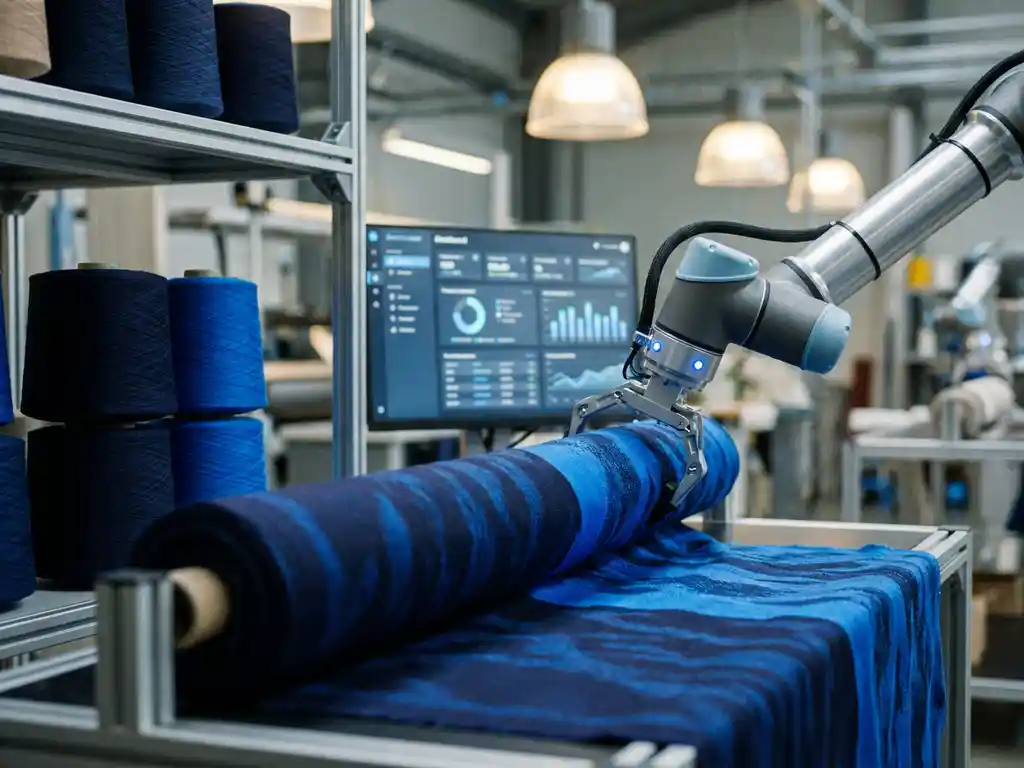
Yes, AI can measurably reduce production costs in the textile industry. The greatest potential for improvement lies not in spectacular one-off solutions, but in the systematic analysis of production data that is already available in most companies but has hardly been utilized to date. The following questions highlight which specific areas benefit from this and what a textile company needs to make it happen.
Which production costs in the textile industry can actually be influenced?
In textile production, material costs, machine utilization, scrap rates, and setup times, in particular, can be directly influenced through better planning and analysis. In many companies, these four areas account for the largest share of variable costs and respond most strongly to data-driven optimization.
Material costs often arise not only from the purchase price, but also from inefficient cutting, incorrect batch sizes, or poor inventory planning. Ordering too much too early ties up capital. Ordering too late risks production stoppages. Machine utilization is another factor: If machines are idle too often because orders are poorly planned or maintenance needs aren’t identified in time, unit costs automatically rise.
Scrap and rework are particularly costly in the textile industry because defects are often not detected until late in the process—for example, during the fabric inspection—even though the actual defect originated much earlier in the weaving or knitting process. And setup times—that is, the time between two production orders—add up to significant capacity losses over the course of a year.
How exactly can AI reduce costs in textile production?
AI reduces costs in textile production by identifying patterns in production data that humans overlook and deriving specific recommendations for action from them. This applies primarily to predictive maintenance, real-time quality assurance, and optimized sequencing.
Specifically, this means, for example, that an AI model that analyzes machine data can detect that a particular loom is about to fail before the failure actually occurs. This allows for targeted maintenance planning instead of having to accept unplanned downtime.
In quality assurance, AI can analyze image data from product inspections and automatically classify defect types. This speeds up the inspection process and makes it more consistent than manual visual inspections. In production planning, AI can optimize order sequences to minimize setup times, for example by grouping similar colors or materials together for production.
It’s important to note that AI doesn’t replace good planning—it makes it more precise. The benefits don’t come from using AI alone, but from a combination of clean data, clear processes, and the right tools.
What is the difference between AI and traditional ERP automation?
Traditional ERP automation follows fixed rules that humans have defined in advance. AI, on the other hand, learns from data and recognizes patterns that cannot be captured by simple if-then rules. The difference lies in flexibility and the ability to handle uncertainty.
For example, an ERP system can automatically trigger a purchase order when inventory levels fall below a defined minimum. This is rule-based automation and is very useful. However, it does not take into account whether a seasonal peak is approaching, whether a supplier is experiencing delivery issues, or whether demand is currently shifting.
AI can identify such correlations when trained with the right data. It can make predictions, detect anomalies, and provide recommendations that go beyond fixed rules. In practice, AI and ERP work best together: ERP provides the data foundation and controls the processes, while AI provides the intelligence that improves decision-making.
For textile software solutions This means that a modern ERP system serves as a foundation on which AI capabilities can be built without requiring companies to overhaul their entire IT infrastructure.
What data does AI need to function in textile production?
AI in textile production requires, above all, structured, consistent, and historical data from day-to-day operations. This includes machine data, order data, quality data, and material consumption figures. Without a solid data foundation, even the best AI model will not deliver useful results.
Specifically, these are:
- Machine data: Operating times, downtime, error logs, energy consumption
- Order Details: Setup times, lead times, lot sizes, delivery dates
- Quality Data: Reject rates, types of defects, rework effort
- Material Data: Consumption Volumes, Delivery Times, Inventory Trends
Much of this data already exists within companies, but it is not centrally recorded or is scattered across different systems. An integrated ERP system that covers all these areas is therefore a prerequisite for the meaningful use of AI. Anyone still working with spreadsheets today should take this step first before even considering AI.
Is AI affordable for small and medium-sized textile companies?
Yes, AI is becoming increasingly affordable for SMEs in the textile industry. Getting started doesn’t have to involve large investments. Many useful AI features are already integrated into modern ERP and MES systems or available as add-on modules.
AI used to be something only large companies with their own data science teams could afford. That has changed. Cloud-based solutions significantly lower the barrier to entry because they don’t require companies to maintain their own server infrastructure, and costs remain predictable. Many providers offer modular solutions that allow companies to start with one area and expand gradually.
It’s important to keep expectations realistic. AI is not a panacea, nor is it a substitute for well-organized processes. But for a medium-sized textile company looking to improve its production planning or reduce its scrap rate, there are tools available today that can make a real difference without requiring a major IT project.
What are the first steps a textile company should take toward AI?
The first step toward AI is not selecting an AI tool, but rather creating a clean database. If you do not collect your production data in a structured way, you cannot use AI effectively. The next step is to identify a specific use case with measurable benefits.
A logical order would look like this:
- Digitizing Processes: If an integrated ERP system is not yet in use, this step should come first. Only data that has been digitally recorded can be used by AI.
- Check data quality: Is master data complete? Are order data, machine operating times, and quality data systematically recorded?
- Select a specific use case: For example, reducing setup times or improving inventory planning. A clearly defined goal makes success measurable.
- Launch a pilot project: Start small, measure results, then scale up.
Those working in the textile industry have an advantage here: the processes are well documented and the data is available. It’s usually not about inventing something new, but about making better use of existing information. Learn more about how digital solutions along the textile value chain can be used is a good starting point for your own planning.
How update texware Helps Make AI Useful in Textile Production
Here at update texware, we know that the path to AI in textile production begins with a solid digital foundation. That’s why we’ve tailored our portfolio specifically to this need: texware/ERP serves as the central database for all production and business processes, texware/MES controls production in real time, and texware/Monitoring collects operational data directly from the machine.
Here's what that means for you, specifically:
- All production-related data is collected centrally and in a structured manner—exactly the foundation that AI applications need.
- texware/DeepSee makes production and business data analyzable in real time, allowing you to identify patterns before they become problems.
- The modular design allows you to get started gradually with minimal risk: You begin with what you need right now and expand as your business grows.
- Our consultants come from the textile industry or are very familiar with it. You don't have to explain how your industry works.
If you'd like to know what a first step for your business might look like in practice, Please feel free to contact us. Together, we'll identify where your greatest leverage lies.
Related Articles
- What consumer habits prevent a functioning circular economy for textiles?
- Can AI-driven manufacturing reduce the scrap rate in the textile industry?
- How do you implement energy management in the textile industry?
- When Is Energy Monitoring Worth It for Small Textile Companies?
- How can electricity consumption be reduced in a textile manufacturing facility?